
We asked for you to send in stories about your first summer job. From the submissions we received, we chose three essays about three very different summer experiences to post.
Sally Walsh writes about the summer after her freshman year in college when she first came to the Vineyard with her friend Mimi. Lynn Ditchfield sent in an essay about her summer job in New York city that is set against the backdrop of the civil rights movement and has a gut punch at the end. And Dorothy Pitt brings readers with her right onto Tashmoo Farm, where she spent summers tacking up ponies and learning life lessons.
“What do you want to do this summer?”
By Sally Walsh
“What do you want to do this summer?” my friend Mimi asked me in early April of our freshmen year, walking back to our dorm after dinner.
“I don’t know, but let’s live near a beach, work, and have some fun.”
Both of us grew up in Pittsburgh, and had spent summers doing volunteer work and hanging with friends. Those summers were fun, but we knew we wanted more.
“How about Martha’s Vineyard?” I have no idea where the thought came from. Neither of us had been there, yet the idea caught fire, and we began planning. Where to live? What kind of job? Would we need a car?
Arriving on the island in early June, we looked in the Gazette at the help wanted, and I found an ad for a job at a deli in Oak Bluffs, and within a half-hour of walking in, I was hired and told to show up the next day.
I had never had a paying job before, had never worked around food, and had no clue what this job would entail. Soon I learned about deli meat, making sandwiches, using a cash register, and clocking in and out. This deli was smack-dab in the middle of Oak Bluffs. We sat next to the tourist bus terminal and found that our main clientele were tourists going on island tours and the cute summer police who were hired to direct traffic in the summer. My fellow co-workers (all female) and I all had crushes on these “police,” and they frequented the deli multiple times a day. Flirting was part of the job.
Within weeks, we became experts on Island geography because we had so many questions. This was also 1976, the year after “Jaws” came out. Answering questions about the movie was part of the job. Music played all day, so I still know all the words of every pop song from the summer of ’76. Just ask me.
We served sandwiches, chips, and potato salad or coleslaw, and on occasion, homemade clam chowder. As a girl from Pittsburgh, I had never had a clam, much less clam chowder. On first inspection, I was aghast. What was in this soup? It looked white, brown, and strange. It didn’t take long to fall in love with it.
To get to work, I hitchhiked or rode a used bicycle along Beach Road to Oak Bluffs. My shifts were five hours, and either before or after work, I would pop over to State Beach for a couple hours and swim, read, and look at the horizon.
The summer flew by, and I left the Vineyard in late August a couple of hundred dollars richer, but vastly happier, with a sense of freedom and a knowledge that I wanted to be part of this Island. The beauty, the freedom, and feeling of community never left me. How was I to know that six years later I would marry a guy with roots on the Vineyard, and, we, in turn would do the same years later.
***
Tashmoo Farm
By Dorothy Pitt
“Come, cow, cow, cow …”
“Prince-a-booboo, you cute dog!”
“Girls, get the ponies ready for the first class. Check out who’s up on the lesson list.”
AM radio tuned to “WEEI radio” blaring from the radio mounted on the shelf. (Which we would change to ‘60s music once Libby and Elsie had retired to the house (Libby) or gone to finish the am feeding (Elsie).
These were the sounds of my first job at Tashmoo Farm.
Tashmoo Farm was a magical place back in the 1960s. I’m 12, beginning my first summer job in the barn at Tashmoo — mucking out stalls, getting ponies and horses ready for lessons, feeding in the late afternoon. And don’t forget “teatime” following chores at day’s end: sitting around the large table in the kitchen enjoying tea, cookies, fresh veggies, and good company. I begged my mom to pick me up “later” so I could enjoy this end-of-workday ritual.
Libby and Elsie were the doyennes of the farm — keeping the horses and riders happy, running a first-class operation that included riding lessons, breeding Arabian horses and Welsh ponies, serving a multitude of constituents, and creating a culture of hard work, fun, and friendship for all of us horsy girls.
Libby (Belden) and Elsie (McLachlan) ran a tight ship. They came to the Vineyard from jobs at Mass General Hospital to run Tashmoo Farm at the behest of Dr. Alan Butler, who owned the property. When I arrived in the summer of 1964 with my Shetland pony, Highlawn Hilarity (Ty-Ty for short), Tashmoo was a recognized Arabian horse breeding operation, with clients from up and down the East Coast. I was in awe of the operation, as well as the older girls who knew so much about horses, were excellent riders, and were integral to the culture of the farm. At first I was intimidated, but I wanted so much to be a part of this horse nirvana that I was not put off by the fact that I was the youngest worker among these seasoned riders.
I spent the next five summers at Tashmoo. Eventually I became one of the older girls who knew so much about horses. My memories include discipline around horses and horse care, learning dressage, getting up early and riding Tashmoo horses to the horse show at the Ag Fair, riding in a triple-class with Freddy Fisher and Mary Stockton, opening the gate down by the lake for additional overnight grazing, and galloping bareback back to the barn on the ponies at the end of the day.
Ty-Ty became a bit of a celebrity at Tashmoo. She was the pony who was harnessed into a Sicilian donkey cart (complete with a harness of plumage and bells) that was painted with Vineyard scenes by an Island artist. As well, while I rode a horse or pony to the fair, Ty-Ty rode in the back of our station wagon (see M.V. Museum movies for proof of this).
****
That summer in the city
By Lynn Ditchfield
I get off at the Melrose Station in “Spanish Harlem,” South Bronx. I run from the train tracks under a passageway, holding my nose tight to get to the other side without inhaling the odor of urine-sprayed walls. Then I’m here … another world, another language. I feel so alive, more at home than in the isolating suburbs of my mother and grandmother’s house. I arrive, a camp counselor at the Bronx Union YMCA — Hydee Hay, Hydee Ho, Iggly Wiggly Woggly Woo — connecting to a new community, a universe of class, race, friendships, taboos, with joyous rebellion sprouting from my 16-year-old soul.
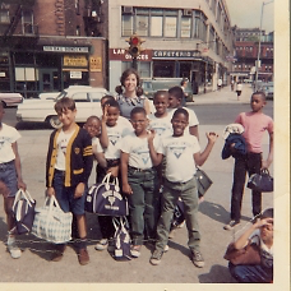
It is the time of Martin Luther King, when minds are expanding, and the heat and humidity act like a pressure cooker ready to spew out anger at the blatant inequities. Harlem erupts. My father, dedicated to fairness, leader against all forms of discrimination, is beside himself with worry that I am working near the “riot zone.” I am deaf to his concern, defiant, tucked neatly in my teenage armor, proudly wielding the sword of discontent, uniformed in make-believe antimilitary regalia, fists held high to mark my victory in a cause, swept away with the passion for justice, for equality, for truth, for truth, for truth. Now it is I witnessing injustice, inequality and lies, lies, lies, seeing hypocrisy so vividly even in my daddy, my champion. I flex my newly found independence, finding my voice in the tone set by Malcolm X.
In this, our last phone conversation, my dad begs me to stop. My mother intrudes on the line, defends my right to work where I want. She rarely approves of my behavior, and hardly ever speaks to my father since their divorce years before. I feel defended, and only slightly aware that she takes joy in my defiance. He is livid, adamant, upset about my safety. I am sure of what is best, proud to win an argument, our first and only argument. Stretched between the drunken fits of my mother, only worse since my stepfather’s death, and my father, his Saturday lunch visits competing with my teenage friends and my summer job that pull me farther away from him. I find shelter for my own rage caught in the flames of the Harlem uprising, oblivious to my embattled parents who fight a much deeper war.
The next day, July 23, 1964, comes his heart attack.
Who says that words do not kill? Take off the “s” from sword, put it on the end for words. My words, the venomous weapon that struck you dead. You were my hero, yet I stabbed you with the very language you taught me.
You are here in the faces of my children. My precious grandchildren wear your smile. Your grandchildren, your great-grandchildren. Death was so sudden it did not wait to give me the chance to tell you I will love you forever.