
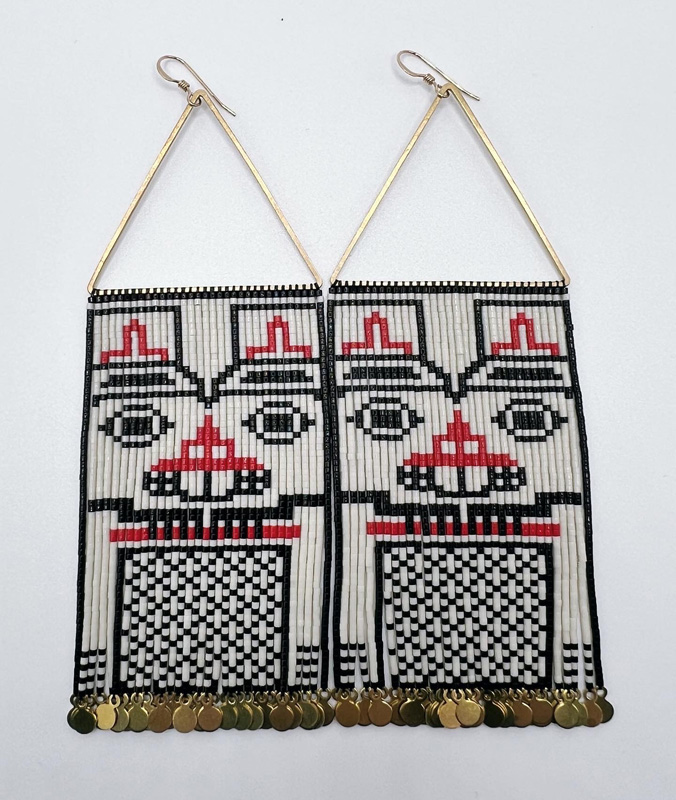
Art flows through Tiffany Vanderhoop’s veins. She comes from a long lineage of Haida weavers on her mother’s side who have carried on an artistic tradition since time immemorial. An exquisite sense of color and design course through all her creative endeavors.
Vanderhoop is perhaps best known for her arresting earrings that combine the Aquinnah Wampanoag heritage of her father, David Vanderhoop, with that of her mother, Evelyn Vanderhoop, who hails from the Haida tribe of the Gaw Git’ans Eagle Clan from Haida Gwaii, British Columbia.
Although living in Shrewsberry, Mass., Vanderhoop frequently comes to the Island to visit family and friends and practice Wampanoag traditions. “I feel blessed that I have that unbroken generational connection,” she says.
Vanderhoop’s artistic journey began when she was growing up here. She learned a bit of loom beading when she was about eight years old as well as traditional weaving from her sister in her late teens. Later, Vanderhoop continued to study more intensely with her mother, a master weaver and teacher, pursuing it as a profession for some 10 years.
In 2016, Vanderhoop turned to beading. “I felt I had to do something more connected to my father’s tribe and roots on the Island,” she says. At first, her style was eclectic, incorporating different materials, including wampum and quills. She did well and enjoyed selling her bracelets, necklaces, and earrings at Wayward Wampum, a store owned by Aquinnah Wampanoag jeweler Jason Widdiss.
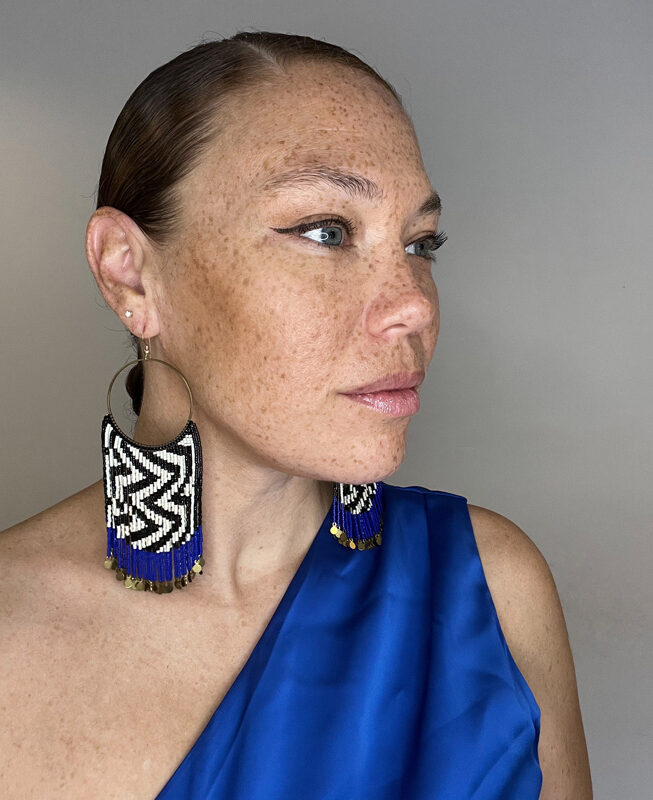
However, Vanderhoop’s trajectory changed dramatically when she hit upon incorporating her distinct Northwest Coast weaving designs into beaded fringe earrings. She creates striking pieces, meticulously beading individual strands that cascade down from large brass frames.
Vanderhoop spends two to twelve hours fashioning each masterwork entirely by hand. Her labor-intensive process begins with inventing the design, transferring it to graph paper, and then selecting the beads. She has discovered that cylindrical Japanese Miyuki Delica beads allow her to create crisp images. “It’s really hard to do it with round beads, which often have inconsistencies,” she explains.
Vanderhoop finishes each strand with small brass ornaments, which, by adding just a bit of weight, help the earrings sway and flow like mobiles as they follow the movement of the wearer’s head.
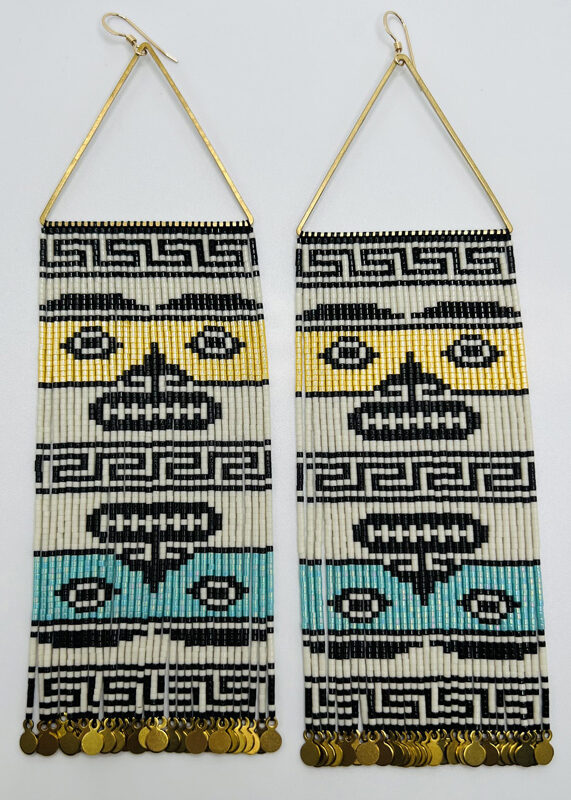
Vanderhoop’s signature art is not only arresting but imbued with her ancient lineage and meaning. She works in two styles with deep cultural roots embedded in indigenous Northwest Coast art. These styles are a tribute to those that were forcibly extinguished during colonization but have been assiduously revitalized thanks to the efforts of Cheryl Samuels, who traveled extensively to study remnants of the 11 remaining historic robes. Samuels reverse-engineered the technique and then gathered and taught several elders from Northwest Coast tribes who went on to teach others. Hundreds of weavers, including Vanderhoop, continue to pass the knowledge on to others.
We see the older Raven’s Tail weaving style in her earrings that bear bold, geometric black-and-white patterns with touches of turquoise or yellow. The Naaxiin [NA heen] designs carry formline images of supernatural beings, bears, eagles, and clan crests seen on Northwest Coast totem poles, robes, blankets, and ceremonial objects.
“A lot of the patterns I use have been passed down from my ancestors,” says Vanderhoop. “They’ve got this history and are conversation pieces.” Starting a conversation is actually an essential part of her work. “It’s about spreading knowledge. People interested in investing in somebody’s art want to know what it’s about. It’s art and fun, but you can also delve into the meaning and history of it.”
In 2018, Vanderhoop established her brand and business Huckleberry Woman, an English translation of her Haida name, S’idluujaa. “When I was little, I was one of the only ones with bright red hair. But even pre-contact in the Haida tribe, every so often, there were redheads. Out west, huckleberries are red, and my great Raven auntie called me Huckleberry in Haida, and the name stuck.”
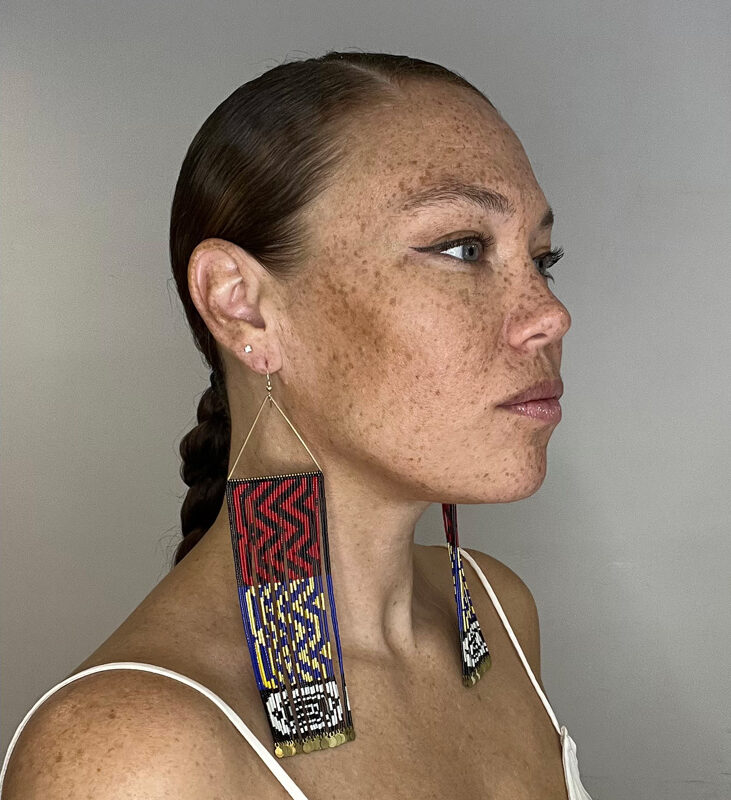
Vanderhoop is part of the wave of increased public awareness of indigenous culture. “When I was starting, issues of appropriation were coming forward about companies that have no affiliation with native people using indigenous designs and making money from that. As people were learning about exploitation, they began supporting native artists and native brands.” Watching her peers gain recognition helped Vanderhoop realize she could make a career of it. “I have many friends who are supporting each other. I feel uplifted and very lucky. And it’s important to reciprocate.”
Vanderhoop credits her acceptance into a prestigious online art collective, B. Yellowtail, as an early boost to gaining wider exposure. Recognition of her work continues to increase. Vogue magazine published an article last December, and actors from Martin Scorsese’s film, “Killers of the Flower Moon,” wore Vanderhoop’s earrings to press conferences. The Boston Museum of Fine Arts has two pairs in its collection and carries her earrings in its gift shop. She is also working with Eighth Generation to design a blanket for Native Harvard students that were to be distributed at graduation.
Vanderhoop primarily sells her earrings and takes weaving commissions via her website. Of late though, she is also beginning to work with indigenous brands to create apparel such as hats, scarves, boots, and sweatshirts adorned with her distinctive designs.
Vanderhoop refers to her earring pieces as medicine. “Putting a pair on can really lift your spirits. It brightens your face and makes you feel more confident.”
For more information about Tiffany Vanderhoop, see huckleberrywoman.com or instagram.com/huckleberrywoman.