
Try as I might, I just can’t seem to write a Munro-esque story.
I have been trying to write short stories. Fiction. Forever. With no luck.
Every time I read a short story by one of my all-time favorite authors, Alice Munro, they seem so simple, so seemingly doable, that I immediately sit down and start to write my own Alice Munro-ish short story. That’s what a muse is for, right? I must have about forty-seven Alice Munro-like beginnings.
Munro, who died in May at the age of 92, wrote about ordinary people from small towns in rural Canada. It’s true, I don’t have a big relationship with Canadian small towns or rural Canada. But I live in Chilmark. I know small towns and I know rural. How hard could this be? I know how a town can get divided over pickleball and tennis, and can come together over fighting racism.
Munro wrote about the complexities of human relationships and the passage of time. At the age of 83, I also know about the complexities of human relationships and the passage of time.
So what’s my problem? Why can’t I just write my own version while copying that delicious style she has? (That was a rhetorical question.)
I start and nothing goes anywhere. So I give up. I think, obviously, I don’t have that talent. But today I happened to be reading Raymond Carver’s essay “On Writing.” Carver says that it isn’t talent that distinguishes one writer from another. Hmm. Well, if it’s not talent that differentiates me from the big boys (or the great Alice Munro, in this case) what is it?
Reading Carver’s essay reminded me that it’s your unique and exact way of looking and then expressing that way of looking. It’s the writers’ particular and unmistakable signature on everything he writes that makes him (I’m sure he meant her too) special.
In 1981, an editor who was interested in publishing a story of mine invited me to meet him at a restaurant. After our introductions he took out what he called my “manuscript.” No one had ever called anything I wrote a manuscript, so I already loved him.
He proceeded to take out a pen and circled the top third of the page. “This,” he said, as he poked his pen into my tender paper, “is shit!”
I swear, that’s what he said. Remember, I had never met the guy and he’s the one who called me. And then he circled the bottom third of the paper and said, “This? This is garbage!”
Well, now you can imagine what’s going on in my little head and big (about-to-break) heart.
And then he did this huge circle of the entire center of the piece and he said, “This? This is gold. This!” pointing the pen over and over until it made a hole in the paper, “This,” he repeated, “is your voice.” He said, as he poked the pen into the top third again. “Here you are quoting Shakespeare. Everyone quotes Shakespeare. I don’t need that.” And then he dropped to the bottom of the page and he said, “And here you are quoting Woody Allen. I love Woody Allen but everyone quotes Woody Allen. I don’t need that.”
I said, using my tiniest vocal chords because at this point I didn’t know if I existed anymore, “What’s my voice?”
He said, “It’s authentic. It’s one-of-a-kind. I believe this person. She is real. It’s not you trying to impress me with how smart you are.”
He was the first authority (other than great English teachers I had) who gave me permission to sound like myself. That I was enough.
Eventually and miraculously I got a column in the Hartford Courant, my local paper, and in1987 I wrote a piece about getting an AIDS test. No middle class lily-white straight woman in suburbia was having, or at least admitting, they had taken an AIDS test. It was still stigmatized and those who were sick were ostracized. The testing place was in a rundown building in a dangerous neighborhood.
In my piece I had made it clear that I wasn’t worried because of a blood transfusion. I hadn’t come right out and said I had been having — how did we used to say it — little indiscretions. But it was obvious if you were actually reading, there it was, on the page. My confession. Before submitting it, I had read it to my mom and my husband and my kids for their okays. And everyone gave me the green light.
I sent it in to my editor and a few days later he said he loved it, it was courageous and risk-taking and important and he was putting it in the next Sunday’s paper.
And then my mother called. “You can’t publish that story,” she said in her serious voice. “Why Mom?” I asked. “Because,” she said, “the kids’ friends won’t be able to play with them once their parents see that article.”
I turned to 11-year-old Dan and said, “Gram is concerned that once the AIDS piece goes into the paper, your friends won’t be allowed to play with you anymore.” The brilliant boy took the phone and my hero said, “If my friends can’t play with me anymore because my mother was honest, then they’re not really friends.”
But I had to consider my mother’s concern. Which I realized really wasn’t about my kids but about her and what her pals would think. Boy, Henny’s daughter has really gotten off the rails this time.
So I called the editor and told him he couldn’t use it, but that he could use a pen name, which I reluctantly settled on, but then got excited about.
And this is what he said: “They won’t need your name. They’ll recognize your voice.”
The biggest compliment ever!
So there it is. That it’s not about talent. We all have talent. We just have to trust how we sound and what we think is worth sharing. That our take on life might be interesting, and maybe even enlightening for some.
So maybe my characters in my Alice Munro imitations are not authentic. Maybe I’ve been trying to make them smart and impress the reader with how much they (I) know. Maybe they haven’t sounded like real people.
Is it possible that this could be a metaphor for our actual relationships? Call the shrink. I think we’re onto something.
Who knows? Maybe Alice’s next story will sound a bit like me.
P.S. When I wrote this piece back in May and read it to my writer’s group, instead of the praise I was expecting — because they know I need praise before any criticisms — they said, “Did you know Alice Munro died three hours ago?”
No. I did not know.
So, this becomes my tribute to a great writer and inspiration.
Sad to have read more recently something about Alice that tarnishes or affects everything, but I have to learn to separate the talent from the person. Now Alice, please move over.
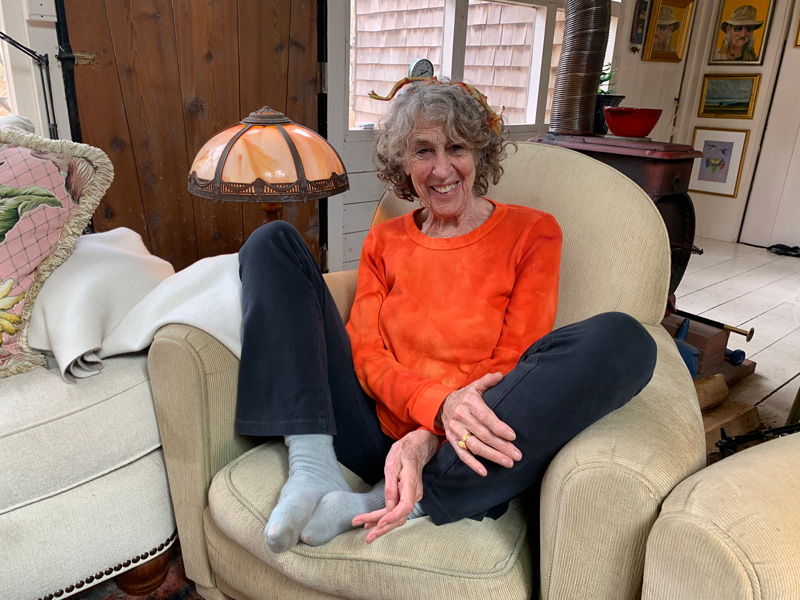
Nancy Slonim Aronie is the author of “Writing from the Heart” (Hyperion) and “Memoir as Medicine” (New World Library) and the upcoming “The 7 Steps to Writing the Perfect Personal Essay: Crafting the Story only You Can Write” (New World Library). She was a commentator on NPR and is the founder of the Chilmark Writing Workshop. She will be speaking at Islanders Write in August.