
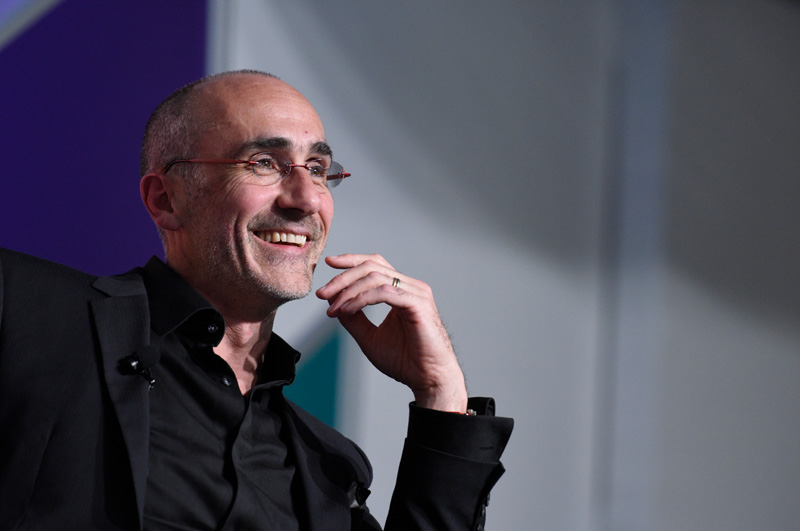
Is happiness a state of mind, a goal, a myth, or right here on this Island? We asked an expert.
We all want happiness — whatever that is — right? Many people come to Martha’s Vineyard to escape the pressures and tensions of life on the mainland in favor of an “island” of simpler life. Many even call it their “happy place.” Can a person search out and find happiness? In a place? Or a state of mind? We went to one of the world’s happiness experts, Arthur Brooks, Harvard professor, social scientist, and bestselling author who “uses the highest levels of science and philosophy to provide people with actionable strategies to live their best lives.” In fact, happiness is in such high demand, and evidently short supply, that it’s hard to get to Brooks, but we did and asked him to help find that elusive state we all want.
Arthur, you teach happiness. And you write books about how to become happy — “Build the Life You Want.” So, can we “learn” to be happy if we’re not currently happy?
Absolutely. This is the foundational premise of my work at Harvard and with the wider world. Research shows us that happiness doesn’t exist on a binary spectrum. Folks are not “happy” or “unhappy”; rather, some are happier than others, and all of us have work to do. With the right habits, anyone can become happier.
You distinguish between pleasure and enjoyment this way: “Pleasure happens to you; enjoyment is something that you create through your own effort.” How do we find the discipline to make the right choice?
Pleasure is an emotion we share with most animals, and it has evolutionary uses. For instance, we find pleasure in sweet foods because thousands of years ago, foods that tasted sweet — such as fruit — were highly nutritious and kept us alive. But in modern times, we are very good at hacking the pleasure centers of our brains to ill effects. Drinking, smoking, doing drugs, and gambling bring momentary pleasure, but they’re hard on our health and happiness in the long-run. But enjoyment is a uniquely human phenomenon. It takes pleasure and adds two essential components: people and memory. To pursue enjoyment over pleasure, I recommend a simple rule: Never pursue your sources of pleasure alone. Limit your drinking to social occasions. If you love to shop, do it with a friend. This rule will keep pure pleasure at bay. With the most destructive forms of pleasure (such as drugs or smoking), I recommend seeking help to quit.
Does “place” matter? Does it help to escape — say, by ferry — from the pressures of hectic, tech-dominated, crowded places — big cities and suburbs — to quieter, less competitive places where turkeys crossing the road have the right of way? Can people be happier on an island like Martha’s Vineyard than on the mainland, in Boston or New York or LA?
Place does matter, but only to an extent. People will often ask me whether they’ll be happier if they move to California — with more sunshine. The data shows that happiness does increase temporarily…but after about six months, we return to our baseline happiness level. However, research shows that nature has fabulous benefits for our happiness. It helps lower stress, improves our attention, and can lower pervasive symptoms of anxiety. For those in big cities, it is essential that you schedule nature time. (I recommend Martha’s Vineyard!) You could consider moving, if other areas of your life will also benefit…[with] good opportunities for a career, finding friends, and staying in touch with family.
Is quiet better than noisy? Can you get off the treadmill, out of the rat race, and find inner reward or do we have to keep score? Are farmers and artists happier than hedge fund managers?
Generally, quiet is better than noisy. It can be exhilarating to live in a fast-paced environment, but developing “meaning,” one of the key “macronutrients” of happiness, requires mindfulness and introspection. In the rat race, we tend to move very quickly from one thing to the next, never contemplating the arc or purpose of life. It doesn’t matter whether you’re a farmer or a hedge fund manager; what matters is that you schedule time to detach from your busy-ness, or screens, to spend time in journaling, meditation, or prayer…to anchor ourselves in the present…to reflect on our concerns and personal goals.
Does work matter in happiness? You’ve had several careers, from musician to analyst, to military research, to economics professor, to think tank guru, to author and philosopher. Do you recommend that people change their lives in search of happiness? At what point does a search become just wandering? (Many people have come to Martha’s Vineyard seeking a new life. Some find it; some don’t.)
There is no one correct way to build a career. My father was a lifelong mathematics professor at a small college in Washington state, and he really enjoyed his career. [Look for] a career that has two ingredients: (1) earned success and (2) work that serves others. Earned success means that your hard work is rewarded, you have opportunities for advancement, and your achievements are recognized. [And] you should be able to point to ways in which your job improves the lives of others. This doesn’t mean you need to work for a nonprofit that serves the marginalized; my father believed that he served others by teaching young people calculus. [But] if your current career doesn’t fulfill the two pillars above—then it might be time for a switch.
Can money buy happiness? Is there a level of money that helps one become happy? Is there too much? How do you balance ambition with having enough?
A lot of scholars have studied this question. About a decade ago, one paper showed that people didn’t get much happier beyond a salary of $70,000. Other scholars updated this research and contend the real number is closer to $150,000; others say it’s $500,000. In my view, we shouldn’t get hung up on a particular dollar figure because everyone’s circumstances are unique. What we should focus on is that all the research shows that there is a ceiling (usually a relatively modest one) at which money provides no further happiness. This should come as a warning for those who primarily seek happiness via wealth. Accumulating more cash is not immoral or wrong, but if you are pursuing money as your highest-order objective, you’ll find that no amount is ever enough to satisfy your happiness.
How do we learn to want less? Can living in a place like Martha’s Vineyard — where cars, fashion, and vanity seem to matter less, while growing, creating, learning, reading, hiking, and friendship mean more — teach us to want less? Is there a self-check people can do to keep themselves grounded in what matters, what really contributes to happiness?
Yes, a “reverse bucket list.” One practical way to whittle down our wants is what I do on my birthday, I list my wants and attachments — the stuff of the world such as luxuries or status. I try to be completely honest. I go to my weaknesses, most of which — I’m embarrassed to admit — involve the admiration of others for my work. Then I imagine myself in five years. I am happy and at peace, living a life of purpose and meaning. I make another list of the forces that would bring me this happiness: my faith, my family, my friendships, the work I am doing that is inherently satisfying and meaningful and that serves others. Inevitably, these sources of happiness are “intrinsic” — they come from within and revolve around love, relationships, and deep purpose. They have little to do with the admiration of strangers. I contrast them with the things on the first list, which are generally “extrinsic” — the outside rewards associated with worldly things. When I reflect on the two lists, I learn to want less of the things that don’t truly matter.
Is there such a thing as a simple life? A life without traffic signals or chain stores? Or is it a state of mind more than a state of situation, location, or vocation? What makes simple simple? Mick Jagger sings “you can’t always get what you want…so get what you need…”
A simple life is more a state of mind than a state of situation. Of course, you can radically change your situation to make life simpler: Quitting your job and moving to a cabin in Montana (or maybe remote parts of Martha’s Vineyard?) would do the trick. But a radical course of action isn’t always practical, and may not bring long-term happiness. Even if you work in a high-stress job and live in a big city, you can make life simpler. Instead of spending your 14th hour in the office, go home to see your spouse and children. Instead of focusing on acquiring extrinsic rewards, go on a getaway with close family or friends. In my own life, I find that daily Mass helps to make life simpler. It makes me realize that I’m small in the grand scheme of things, which is actually quite a comfort.
How do we adjust our happiness as we age? Martha’s Vineyard attracts many who are older, retiring or slowing down. How can we make the process of aging more happily?
People after the age of 70 fall into one of two buckets: their happiness tends to rise or fall — but not stay the same. We all want to be on the upper branch, so how to get there? The Harvard Study of Adult Development, the longest study of human happiness, gives us seven habits of the happiest people with age:
– Don’t smoke (or quit as soon as possible).
– Don’t drink to excess, and quit if you have a family history of addiction.
– Exercise regularly (walking is best, since we can do this into old age).
– Have a balanced diet (no yo-yo diets).
– Continue your education (read, read, read).
– Find a good way to cope with stress (prayer, meditation, journaling, therapy).
– Prioritize loving relationships. The happiest people later in life have rewarding marriages or deep friendships.
How can you be happy when the world is going to hell — politics, poverty, climate, war? You advise, “when you can’t change the world, change your feelings.” How do you do that — change or compartmentalize to be happy but realistic? Can we “escape” to our own Island of Martha’s Vineyard, literally or figuratively, to be happy?
It is important to pay attention to what is going on in the world and to get involved in making it better. But being miserable doesn’t help anyone except the politicians and media leaders that want to channel your anger and sadness into their power and influence. Remember, when you hate someone because of politics, or can’t sleep because of something you read on social media, you have almost certainly become someone else’s product. Give to a cause you care about, do something locally that helps, enjoy nature, and then focus on the love and happiness in your life and that which you can bring to others.
Arthur, we’re not happiness experts, but perhaps on your next reverse bucket list, you can replace something you want but does not bring you happiness with a trip to the Vineyard — clamming in Tashmoo, kayaking at Chappy, swimming off of Aquinnah, or just breathing the air.
I have been to Martha’s Vineyard once and I thought it was quite beautiful, quite special. A place may not make people happy, but it can be where people find happiness.