
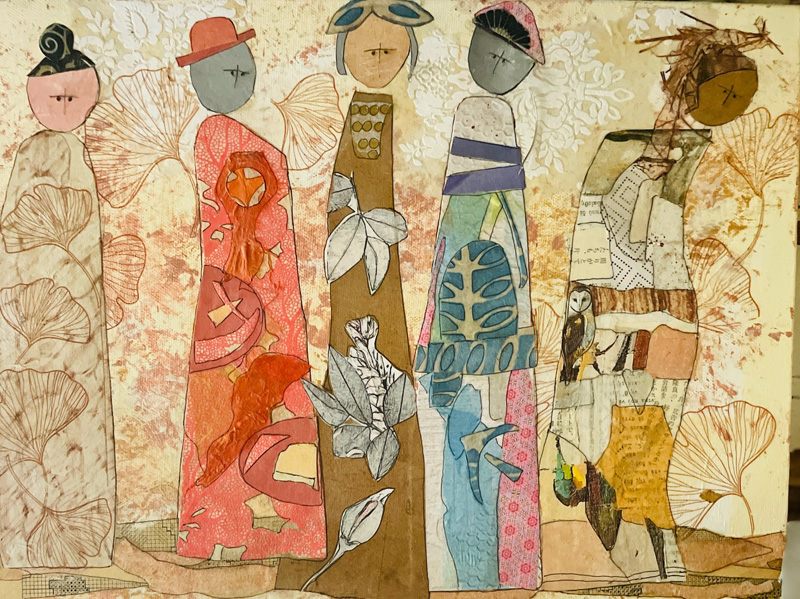
“She #35,” paper collage, 12 x 18 in. —Bricque Garber
Focus on what’s missing and you’ll find the message in Bricque Garber’s work.
It was while West Tisbury artist Bricque Garber was living in Greece that she began her most recent work, the “She” series. Garber and her partner Katherine Triantafillou spend six weeks every year settled into an ancestral farmhouse in a tiny Grecian village, where she focuses on her artwork while Triantafillou writes.
“We go there for peace and quiet,” says the artist. “I try to spend every day working on my art.”
For the “She” series, Garber says she found inspiration in the struggles of women around the world. “Globally, women are really being pushed into the background in a way that I don’t remember in my lifetime,” she says.
Garber almost always has a message to convey in her mixed-media pieces, which she refers to as “intuitive collage.”
The artist uses acrylic paint, torn handmade paper, small sections of patterned fabric, and bits with words or images ripped from magazines to create her colorful multi-media work. In her most recent series, Garber selected a variety of patterned handmade papers to create the women’s clothing and painted over other scraps of paper for the background. She added random bits of newsprint — mostly in Greek in this case. She uses the lettering simply as another design element. “I try to find magazines and newspapers written in foreign languages,” she says, “that way you don’t get distracted by the words.”
The collage images in “She” represent either single figures or groups of women with a notable absence — they are missing their mouths. “Women have been silenced in the most horrible ways,” Garber says. “Women’s voices are not being heard, especially in Afghanistan, but also here in the U.S. with the overturning of Roe v. Wade.”
Garber is represented by the Cousen Rose Gallery in Oak Bluffs, and for her large scale, multi-figure piece from the “She” series, Garber chose to represent a multicultural mix.
“I really want to represent women as a whole,” she says. “The women in these pieces don’t have mouths. It’s all about women in general not having a voice.”