
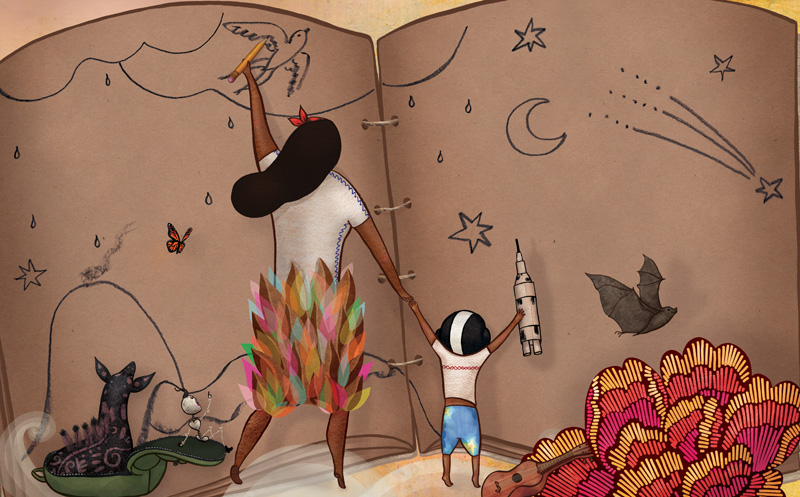
“We Are Stories, We Are Two Languages,” archival pigment print, 14 x 22.5 in. —Yuyi Morales
A sunny “Florida Welcomes You” sign greets drivers on Route 95 after they cross over the St. Mary’s River. Thirty minutes on, they’ll pass the “Entering Duval County” sign and drive into one of the hotspots in the culture war over book banning.
Duval County is home to Jacksonville and boasts the 20th largest school district in the country. (Florida also claims the fourth, sixth, seventh, ninth, and tenth largest school districts, which is of significance to those of us concerned about Governor Ron DeSantis’ policies.) In the waning months of 2022, reports started leaking out that nearly 200 books, most of which were on a list of diverse and inclusive books that had been purchased by the school district in 2021, had been removed from Duval County schools.

One of those books was “Roberto Clemente: Pride of Pittsburgh Pirates” by Jonah Winter, with illustrations by Raúl Colón. Published more than 15 years ago, the 40-page picture book tells the inspirational, and ultimately tragic, story of Puerto Rican-born baseball Hall-of-Famer Roberto Clemente and his career, humility, humanity, and the airplane crash that ended his life while he was enroute to Nicaragua to deliver supplies to earthquake victims. The book does not sugar-coat the poverty Clemente was born into, or the racist slights he encountered while playing for the Pirates, but the book is neither about nor focused on racism.
To explain what the racism Clemente endured looked like, Winter wrote: “As much as fans loved him, the newspaper writers did not. When Roberto was in such pain he couldn’t play, they called him ‘lazy.’ They mocked his Spanish accent, and when Roberto got angry, the mainly white newsmen called him a Latino ‘hothead.’”
When news broke that “Pride of Pittsburgh Pirates,” along with a picture book about MLB player Hank Aaron, was on a banned books list — Florida’s Department of Education euphemistically claimed the books were not banned, but rather “under review.” Sports enthusiasts called foul, and joined the usual suspects in the fight against censorship. The national news media jumped on the story.
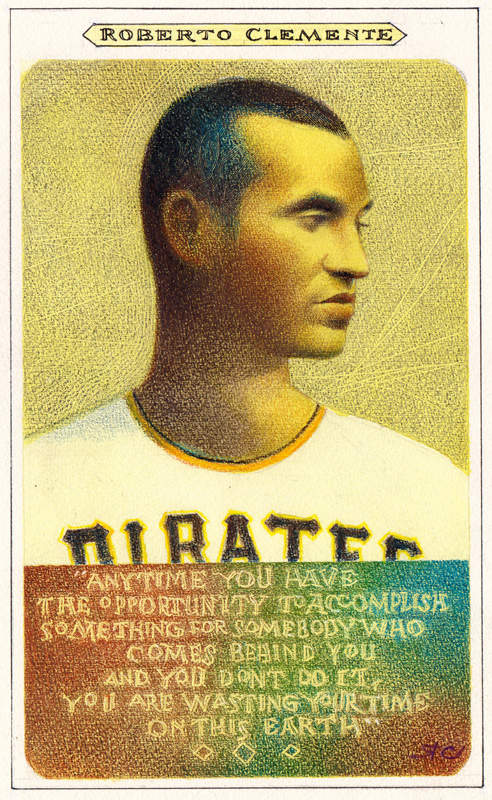
The book’s award-winning illustrator Raúl Colón, whose work has been described as “beautifully euphoric” in Kirkus Reviews, was part of a group show featuring and celebrating the work of acclaimed and award-winning Latinx children’s book illustrators at Featherstone Center for the Arts in July. Colón, who grew up in New York City and Puerto Rico, said that while he wasn’t particularly surprised to learn the Clemente and Aaron books had been banned, he suspects that the uproar in the media blindsided DeSantis, whose administration passed what has been described by the Southern Illinoisan as “the strictest book legislation in the nation” and as “educational gag orders” by PEN America.
“Little did he realize that the law is so broad that books about famous people could also be banned,” said Colón, “So when he saw the book about Clemente and also a book about Hank Aaron had been banned, I don’t think he was too happy about that.”
DeSantis did some back-pedaling and in a press conference explained the ban on the Clemente book as “a joke.”
None of this, of course, is funny.
Colón pointed out that the majority of books that are being contested and removed from school libraries don’t generate this kind of publicity, and those are the stories that can all too easily disappear. “They will remain banned because they aren’t about someone well-known or they are fictional,” he said. And indeed, the books about Clemente and Aaron have been returned to the shelves of Duval County libraries. “You can’t ban Clemente and Hank Aaron,” said Colón.
While the show at Featherstone, which was curated by Richard Michelson of Northampton-based R. Michelson Galleries, was focused on the work of Latinx illustrators and not banned books, a number of the illustrators whose work was shown have had books that have been challenged by school districts around the country.
Another of those artists is Juana Martinez-Neal. Her 2019 Caldecott honor book — the Caldecott being the most prestigious prize in children’s book illustration — “Alma and How She Got her Name” is the story of a young girl named Alma Sofia Esperanza José Pura Candela, whose father tells her the stories of all the relatives she is named after. It’s hard to fathom what anyone could possibly object to in this delightfully engaging story that encourages children to ask about their own family histories. Yet this book was included on the PEN America list of books removed from Duval County school libraries.
“I wish I knew exactly why Alma is part of the list, and maybe I’m wrong, but the only reason I could possibly find is that she has a name that has Spanish names in it. But I don’t know,” Martinez-Neal said when reached by phone. “I just do the work that I think I should do, and hope that other people feel that it is a book they can relate to — that makes them feel seen.”
It should be noted that Florida is not alone in efforts to limit the books that children have exposure to through their school libraries. There has been an enormous uptick in books under so-called review during the past year alone, and according to PEN America, most of them happen to have “themes centered on race, history, sexual orientation, and gender.”
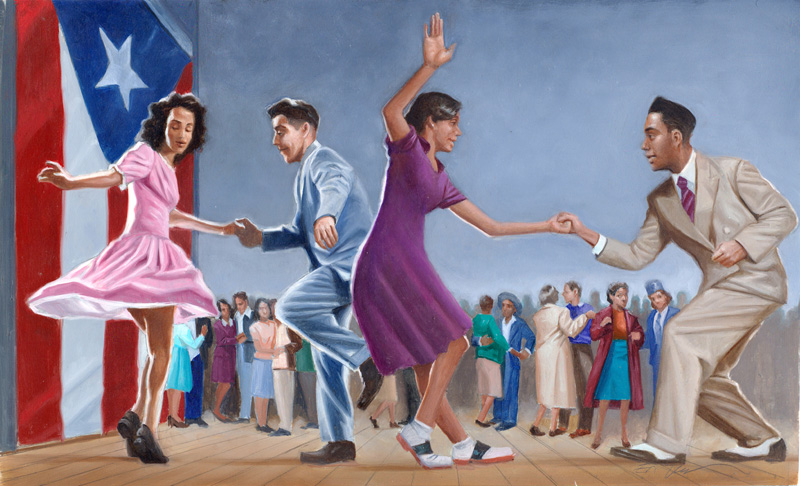
This show at Featherstone was a follow-up of sorts. Two summers ago, Featherstone collaborated with R. Michelson Galleries for the first time and mounted a show of award-winning Black children’s book illustrators. “It was an incredible success,” said Ann Smith, executive director of Featherstone. “The show exposed our community to books and illustrators and subject matter that many people had not explored before.”
“Both shows were a rare opportunity to see an extraordinary exhibition of illustrators,” said Michelson. “They are among the most celebrated contemporary American artists, with the hope of showing the many varied facets of their work; some directly commenting on their heritage, and others just creating wonderful art.”
The show at Featherstone Center for the Arts included the work of Lauren Castillo, Joe Cepeda, Raul Colón, Mike Curato, David Diaz, Frank Espada, Juana Martinez-Neal, Yuyi Morales, Edel Rodriguez, and Eric Velasquez. If you weren’t able to get there, it will next be on exhibit at the R. Michelson Galleries in Northampton, Mass., from Nov. 12, 2023 into January 2024.
Kate Feiffer is the author of 11 books for children, a contributing editor for this magazine, and the event producer for Islanders Write.