
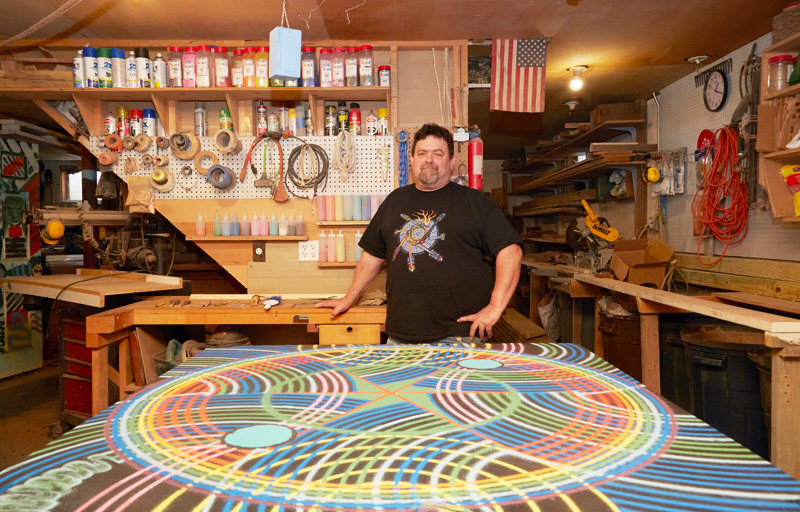
It’s the process, not the final product, that interests the sand artist.
Sometimes people cry over Jeremiah Brown’s work.
“They watch me to the end. And then I say, ‘It’s time.’ They just can’t understand. They say, ‘What are you doing? You’re not going to save something so beautiful?’ I tell them: ‘It’s impermanent art. It’s about doing, not keeping.” Having completed a sand painting to his satisfaction, he sweeps it up, packs up his portable workstation, gets back in his car, and drives home.
It all started in a little sandbox Jeremiah built four or five years ago when his grandson was a toddler. JB (as friends call him) is a Vineyard native and the landscape foreman for Vineyard Gardens, where he has worked for 32 years. He and his wife, Janice Haynes (full disclosure: Janice is this writer’s oldest friend), have created an extensive garden on their West Tisbury property, complete with a homemade waterfall and koi pond. “I wanted a Zen garden in the space, where you paint with a rake in the sand, so I built one in the back, and I just started messing with it on weekends.” One rainy Saturday, he carried some of the sand inside and shaped it into designs on a circular table-top he’d built for his woodworking. “I thought, ‘Wow, this is kind of cool,’ and from there I just started honing the craft.”
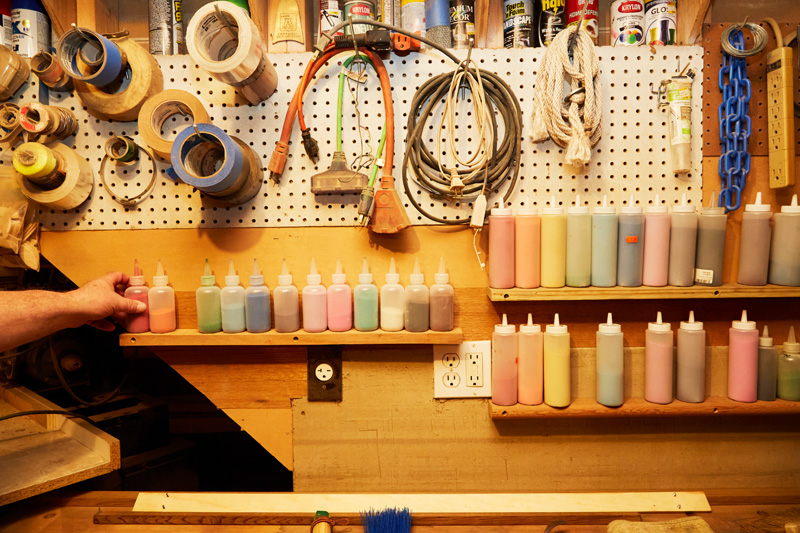

At Janice’s suggestion, he purchased colored sand and decanted it into plastic condiment bottles with the tops snipped off. When asked what his art background is, he smiles and points to his wife. “That’s it,” he says.
Janice attended the School of Visual Arts in New York, and for several years sold jewelry and painted cutting boards (made by JB) at the Artisans Festival. “I’d go downstairs to see his pictures,” she recalls, “and at some point, the artist in me said, ‘Oh, god, you shouldn’t use that color next to that color’ so I scribbled out a very quick color wheel explaining color concept for him — these are opposite colors, those work together, that combo is a little jarring to the eyes, et cetera. Then I bought him a real color wheel with more nuances.” She also gave him one of her adult coloring books with mandalas, encouraging him to lean less toward depiction and more toward geometric.
Shortly after Jeremiah began experimenting with the colored sand, Janice was diagnosed with colon cancer. “Janice’s cancer has a lot to do with my getting invested in this,” he says, “because there would be nights when she was sick from the chemo and only had the energy to watch TV, and I wanted to keep my mind busy because I’d get bored watching television.”
Gradually, he created a dedicated workspace in his basement for the sand paintings. He built a 4×4 tabletop and painted it black, then developed his own large compass with a point that he could set into the many detent points he’d drilled into the table. “I mapped them out across the table so I could draw even and concise circles and squares. Over time I added marks on the compass stick based on previous work — so for instance, if I use the blue mark, I know I’ll get a certain sized circle. I just kept improvising, making things or using things for the purpose. Something as simple as the edge of a whisk broom can get weird wavy stuff going on, or you can pull it straight away from the line of sand to get different effects.” He has a straight edge with little nails in it, so it can sit above the table without touching the sand. He uses foam brushes for very precise work when he wants a clean, sharp edge, and inch-wide disposable paint brushes for swirly designs. A dowel about an inch thick that can be secured into the detent holes has a shoelace winding around it, allowing him to make spirals. He also uses a regular brass compass for creating smaller circles.


When Jeremiah first began, “I’d put a bunch of sand in one corner and I’d practice: what does this color look like with this color, and so on, and then I’d swipe it away and try again until I found something that made me think, ‘That’s cool! Alright, let me do that on a grand scale.’ So I’d practice throughout the week, after work, playing with certain ideas, and then usually Saturday nights, it’s my whole evening, that’s my big one. Or, as of last year, I went to town.”
He means this literally, although it actually began at the beach. One day at Lambert’s Cove, he started “painting” with regular sand, freehand; enjoying the experience, he brought some of his colored sand the next time.
“The beachgoers would come over to watch,” he says. “They’d be mesmerized, telling me how cool it was, as if not recognizing that really anybody could do it. But it was fun to have the audience. So I decided to take it to town one night and see what would happen. Especially since Oak Bluffs in the summer, it’s happening, there’s people from all walks of life around. I had an old piece of plywood outside and an old table frame. I put the plywood on the frame that first time.” After a month or so, he built himself a collapsible table, about three feet square, with wheels so he could roll it up the street; it’s devised with side wings to hold a complete set of sand-bottles and a set of tools like those in his basement, ready to go.
He goes into town to paint most Saturday nights when the weather is good. Janice is still in treatment for cancer, and “we go to dinner together once or twice a week, but she can’t handle hours of activity. I like the constant stream of people asking me questions. I get a lot of neat questions. And sometimes idiotic ones like, ‘What are you doing?’ I’m putting sand on the table, I don’t know how else to explain it.”
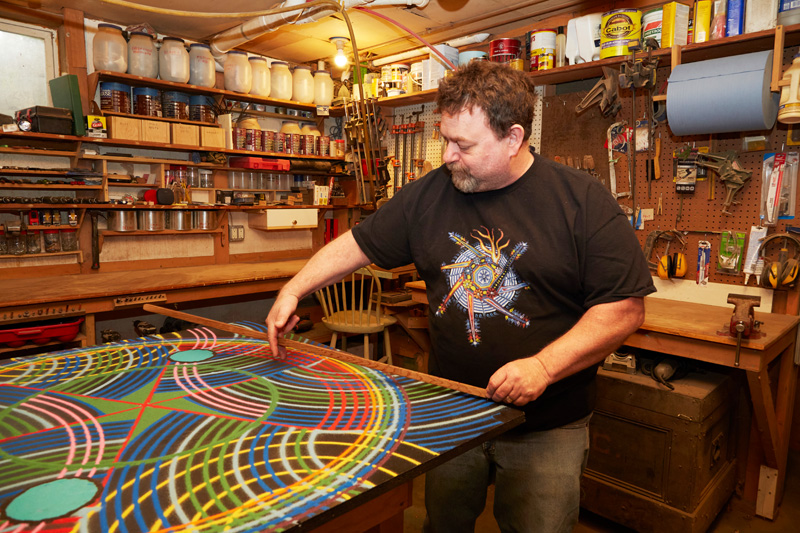
Although he still sketches out ideas in miniature during the week, “Ninety-five percent of the time, I have no idea what I’m doing,” he says. “I go downstairs, I clean the table from the last design, I get it all fresh, and I think: OK, what? I start with a circle, or a straight line, and then I just…go.”
The end results, as you can see, are all very different. “It depends on my mood,” he says. “It might be entirely geometric, or it might be geometric with some funny trippy shit coming out of the sides, or it might be entirely funny trippy shit.”
“Or it might look like a rock-album from the ‘70’s,” adds Janice, grinning.
Jeremiah’s biggest challenge is revamping things that don’t please him. “It’s very hard to backtrack once you’ve laid the sand down. If it’s just a line, you can sweep it up, but once lines are overlapping and intersecting, it’s very hard to fix. Sometimes I’ll lay down a color when I’m well into a painting, and then realize it’s not really what I wanted, it doesn’t look right. So I go in a whole different direction by doing swirls or other blending effects rather than the design I was originally intending, just because I’m trying to erase that color.”
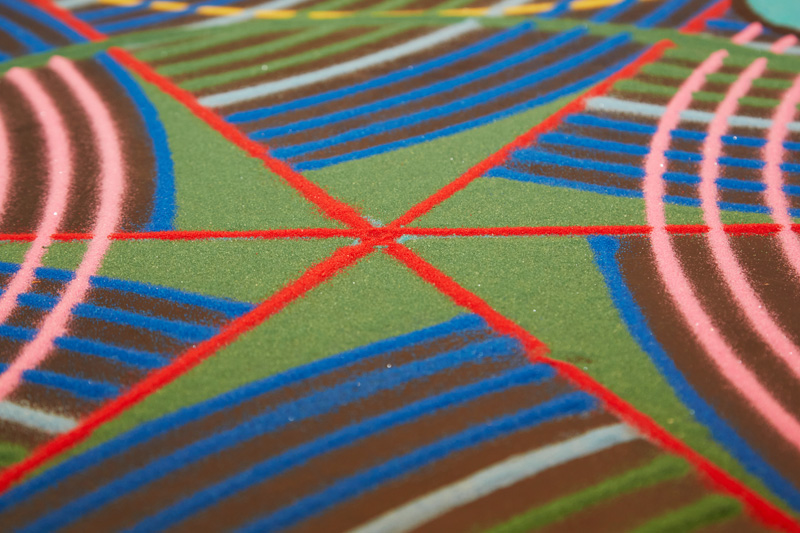
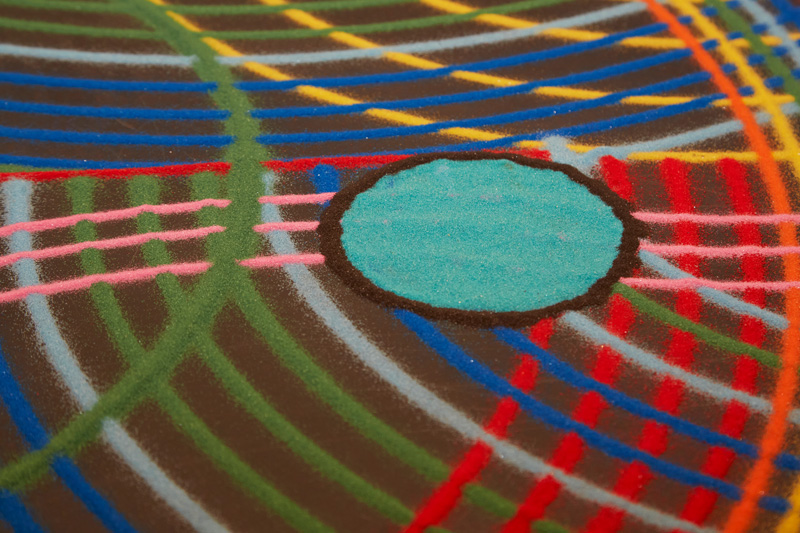
While each sand painting is different, they take an average of about two hours to complete. On some nights in town, he’ll usually do two or even three in an evening. At home, he sticks with a single image, spending more time on it. “Although sometimes I’ll do one and then start messing with it — taking lines and making them into swirls and so on. Some of the better ones I’ve done can take me eight hours. But it’s not usually in one sitting and ergo those are different. Because you work four hours on something when you’re just grooving, and then you work on it a couple of nights later when you’re not in the same mindset, so you do different things with it. I might think after four hours that it’s done, but then I look at it later in the week and I want to embellish or improve something. Every once in a while, if I don’t like one part of it, I’ll sweep just that part away and then do something new in that corner which compliments the rest of it.”
He takes photos of most of the art so that he can show other people.
But then, always, comes the moment of sweeping it away.
Although ephemerality is an essential part of the process for him, he’s open to the possibility of preserving his paintings. “We’ve tried a few different things to accomplish that,” Janice tells me, “like putting them in a frame and covering them with epoxy, but the epoxy darkens them up, and it shifts the sand a little.” She recently found some adhesive sheets for Jeremiah to experiment with but so far nothing has worked. If that ever changes, Jeremiah would be open to selling some of them.
“I think hobbyists, woodworkers and craftspeople, they like what they do, but they’re sometimes thinking, how could this possibly make me some money? That’s not why they do it, of course, and I’m not saying they’d even try to make money from it. Because that part’s difficult.”
This resonates with Janice’s experience of the Artisan’s Festivals. “I love to paint, but when you have to produce, it takes the joy out of it, for me anyhow. You put a huge amount of time and effort into setting up, and then you don’t necessarily sell enough to make the cost of the booth. It just became too much, and financially we were at a point where I needed to have a regular income.” She now works as the administrative assistant at the West Tisbury Town Hall.
“That’s very much my sentiment on the matter too,” says Jeremiah. “A comment I get out on the street from the public is: This is fantastic, you should go online and market this. And my response is always: I have a job. I’m successful at my job, and this is my hobby. I don’t want to have to do this, I’m doing this because I enjoy it, I’m not trying to do this as a living. If it brought in some side income that’d be great, but that’s not why I do it, that’s not my intention at all. My intention is all about the process.”
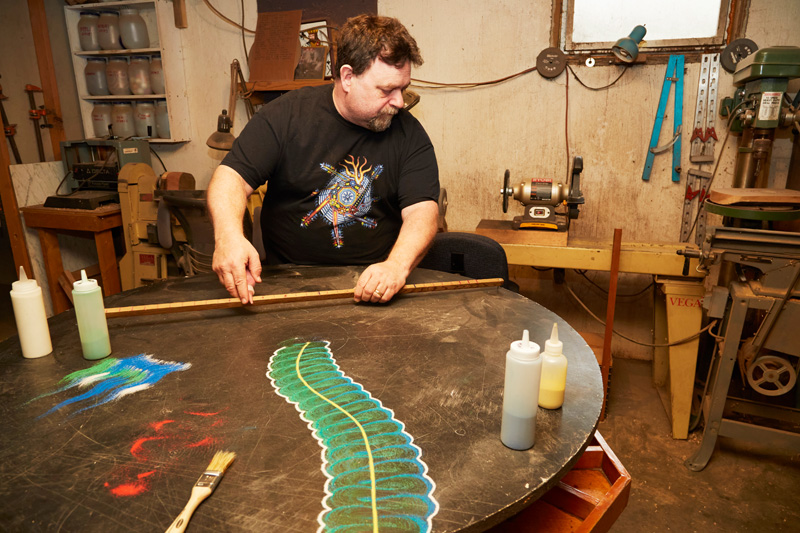
In this, he resembles the most famous makers of sand-paintings. “Tibetan monks make huge mandalas out of sand and then sweep them into little bottles,” he says. “They spend far more time on them than I do. It can take them a year, they will move grains of sand with tweezers, that’s how precise they are. I don’t do that, but their mindset is similar to mine: you’re trying to clear your head. You’re trying to stay out of THAT — television, cancer, worldly distractions, whatever — and instead focus on THIS. I feel good when I’m done.”
Not only does he not want to market online, he doesn’t even care to be seen there.
“I don’t want it to ever become an internet thing. When people suggest that, I say thank you — I like the compliments — but the rest of my response is usually: ‘You don’t have to go online. I’m doing it right here right now, right in front of you. Just look!’”
Editor’s note: Jeremiah’s wife and champion, Janice Haynes, passed away in June.