
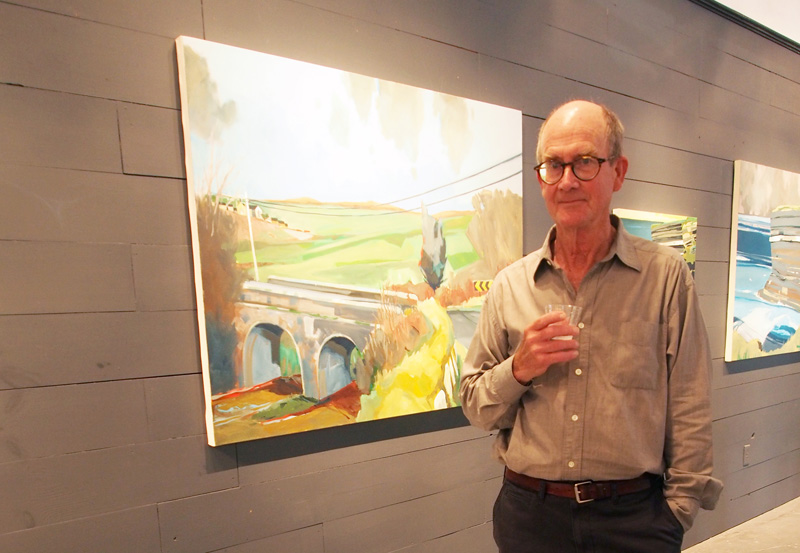
“There are moments in our lives,
There are moments in a day
When we seem to see beyond the usual.”
I began an earlier article about Rez Williams with this quotation by Ashcan School artist Robert Henri. It is pinned above the worktable in his studio, as it was in 2018, and it still feels descriptive of how I remember Rez.
After a conversation with his wife, Lucy Mitchell, she walked with me to Rez’s studio. We talked there for a while, then she left me on my own to look at the four large, last landscapes that were on the walls. Ten small self-portraits were there, too, lined up along the floor.
The studio was much as it always was. It felt as though Rez had just stepped out for a moment and would return, that we would pick up where we had left off talking. The floor was spotted with paint. Bright sunshine streamed in the corner window, raking across Rez’s worktable, where clean brushes sat in cans, tubes of paint were neatly arranged by color, and paint in a fabulous array of colors he had mixed had dried in the ubiquitous tuna fish cans that spread across the table. “We don’t have a cat, but we eat a lot of tuna fish,” Rez had told me long ago.
I had really gotten to know Rez one winter when he taught a painting class on Sunday afternoons at the Nathan Mayhew Seminars. I hadn’t painted since art school and wanted desperately to paint again. This seemed a way to begin and it was. One of the paintings I did still hangs in my house, the old Gilbert & Bennett wire mill in Georgetown, Conn., a place I have wonderful memories of that, sadly, no longer exists.
I had a bunch of old photographs of varying quality that I worked from. That was how Rez and I began our conversations about art, making art, our individual processes, artists we admired, life on the Vineyard as it was changing. We both used the worst photographs, just enough information to remember that a tree lay across a path, or windows went almost as high as a roofline. Of course, all that could be rearranged or changed or left out altogether. That’s the magic of painting.
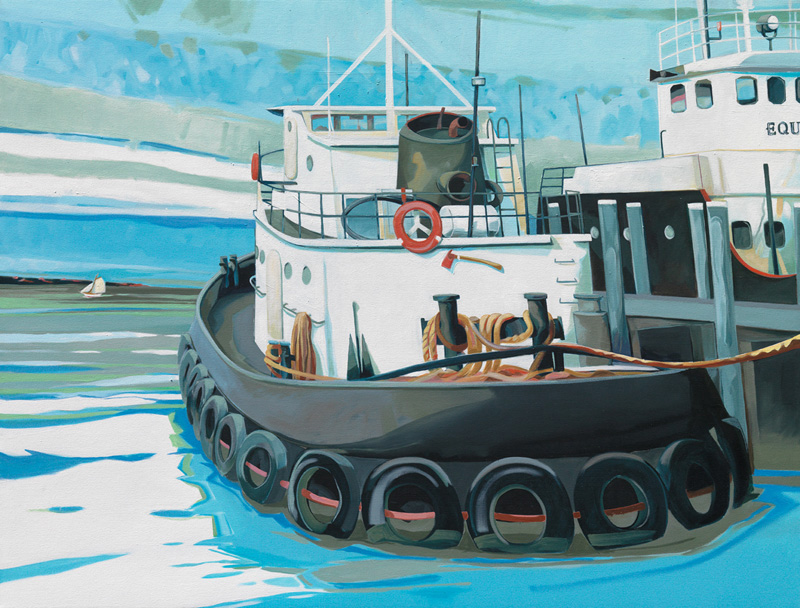
Rez’s working photographs were pinned to the walls beside the large paintings. No one else would look twice at them. One was overexposed. Another suggested something. A meadow. A woodland. A boat in the water. A dark treeline. Rez made something momentous and memorable out of all of them.
The working boat rose in the distance on an olive and purple sea, an oily, viscous surface cut into with “Rez shapes.” A meadow of acid green and yellow was broken by an orange path that led to a mostly solid treeline defined and punctured by a prominently blue sky and a lone tree, all outlined in an electric shock of lemon yellow. A woodland of bare trees and a rivulet of a stream sat aboveground in an ambiguous arrangement that dropped off into a Stygian abyss. In the last painting, a moon of prodigious size and brightness rose above a night-dark line of trees that bisected the composition.
The self-portraits, Lucy said he painted one most every year, were dated from 1988 to 2012. In them, Rez appeared always in glasses, staring straight at the viewer, his head turned or straight on, painted with hard planes butted against one another, or the softest caresses of brushed edges. I watched him age in color.
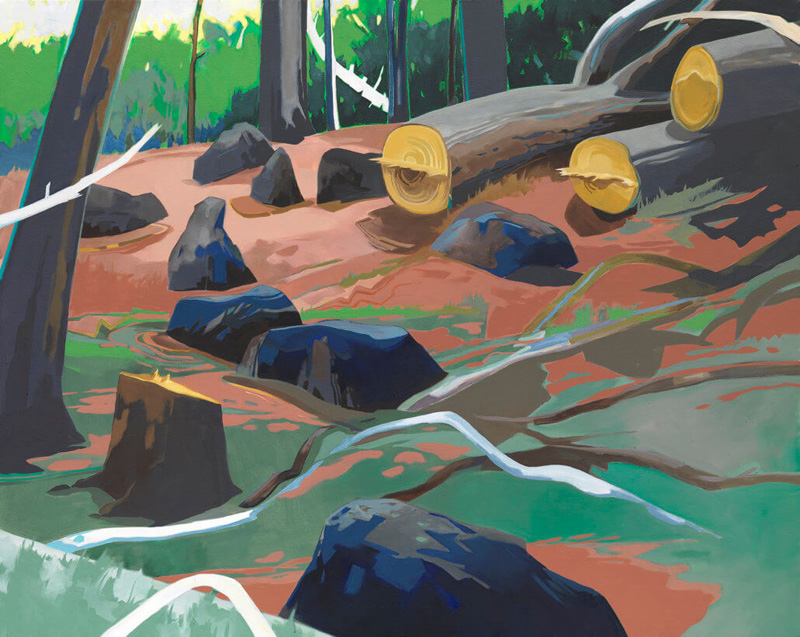
Rez was an ardent conservationist. He was a longtime member of the Vineyard Conservation Society, president of Sheriff’s Meadow Foundation, West Tisbury Path Committee, and recipient of the Creative Living Award. He also relished and wanted to protect the messiness of the Island as well as its loveliest views. He loved piles of fishing gear, stacks of cordwood, rusting farm equipment, electric poles and lines, muddy boots — evidence of real life, of how people worked and lived. His paintings left nothing out, except in service to the painting.
He was a fixer, too. He could look at a problem, figure it out, then make something out of nothing, and make it work. He mourned the days when the town dump was an endless source of useful building supplies, tools, machinery, metal scraps, leftovers from other people’s projects. He often spoke about the way things were when he first arrived on the Island.
I asked Lucy about those early days, seeing Rez’s work at an early show at the Field Gallery, meeting Rez for the first time. She recalled asking him about how he had gotten to the Island, a common enough ice-breaker into a conversation. He was quiet for a moment, then said, “Bus.”
Hermine Hull is a writer and painter who lives in West Tisbury. She writes the weekly West Tisbury column and essays about art for the Martha’s Vineyard Times, Arts & Ideas, and BlueDot.