
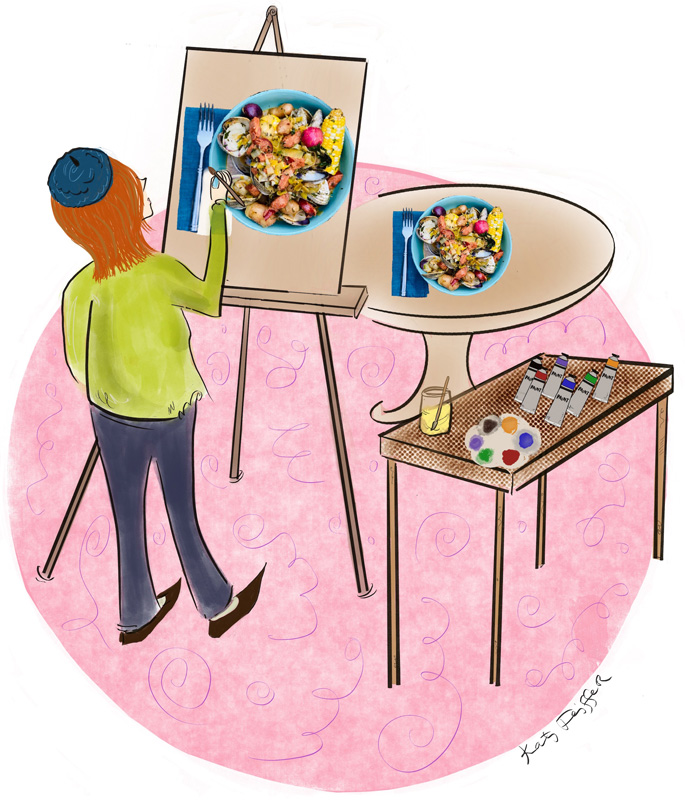
Creating dishes that bring people together and make them happy is true artistry.
I was always creating art, one way or another. As a kid, I drew animals, primarily horses, doodle books, trees, and eyes. I did watercolors of flowers and the sky. I painted canvas with oil and acrylics and carved linoleum to make block prints. My favorite was, and still is, photography. I took black-and-white photos and developed them in the darkroom at the high school. Art became my sanctuary, especially in high school, where success in the art room was not measured by rote learning and pop quizzes but by my creative juices. I felt relief and peace.
My mother was an artist. During my parents’ short marriage, she painted, sketched, and made pottery. In 1966, my 24-year-old mother and her friend Cris Jones opened an art gallery called Christiantown Pottery & Gallery. My father built the little gallery in the woods off Christiantown Road in West Tisbury. I like to imagine that my often tortured, untamed mother was content creating her art in that brief moment of her life.
With so many mediums in art, the question becomes: is food art, especially because it is perishable? Food has been the subject of art since the beginning, with biblical paintings of grand feasts like Leonardo da Vinci’s “The Last Supper” (1498) to “The Wedding Feast at Cana” (1563) by the Italian artist Paolo Veronese. Paintings of excess to prove great economic and social status more than in normal, everyday life. Stunning still-life paintings have glamorized food for centuries, with ripe fruit sitting in beautiful light being the most common. Also, maybe not quite as appetizing, whole dead fish and fowl draped on a table ready to be cleaned and plucked for cooking.
More recently in the last century, hitting the mid-to-late 80s, we have cookbooks with brilliant, colorful photographs of restaurant-quality, chef-inspired dishes stacked high for drama. Mouth-watering desserts created by famous pastry chefs. It seemed like cookbooks were everywhere, but apparently, so was the demand. I was told by a cookbook editor friend from Random House in 2005 that the cookbook market is robust and people could not get enough.
Now jump to today and social media, really Instagram, and that is where the term “food porn” comes alive. Not just food, but people eating food at incredible and iconic destinations. Food experiences shared worldwide immortalizing chefs, restaurants, food trucks, street food, BBQ joints, diners, you name it. iPhones are in wait for the food to be delivered to the table, with no doubt eyerolls from the servers. Everything stops, and the iPhones snap and snap at the craft cocktail, shrimp tapas, charcuterie, and salt cod croquettes, and you post to your people via Instagram as to say “Don’t you wish you were here, don’t you wish you were me?”
Sometime in my pre-teen years, I discovered a new art and the beauty of food. I spent much of my time at my best friend Beach’s house with her family of six. There was always a lot of food, a full fridge, snacks in the cabinets, an extensive selection of breakfast cereals, and a mom who cooked nightly. I hesitantly but gratefully squeezed in for dinner more nights than I can count. But I wasn’t just there for dinner; I was there during the day, and that’s when I started fixing sandwiches for Beach, myself, and whoever else was around. This was my first clue that food was more than just filling for the belly. It filled the senses. The fragrant aroma of melted cheddar cheese draped over a sharp-red burst of tomato over tuna fish on a Thomas’ English muffin. I could imagine the applause as I removed this tasty work of art from the oven. This did not just taste yummy; it looked yummy.
When I turned 17, I spent the summer on a 200-plus acre sheep farm in the Nouvelle-Aquitaine region of France. The farm was surrounded by luscious green fields and forest, hay fields, and gardens. Besides pastry and cheese, almost everything we ate and cooked was grown on the farm. Dinners were prepared by a mixture of visitors like me, who worked on the farm in exchange for room and board. I was the youngest by far, as the others were in their 20s.
The farm owner was away the first few weeks I was there, so things were casual, and we all shared in kitchen activities. During the day, we harvested green beans and peas, and I learned to blanch peas to go in the freezer and make fresh, bright-green pea soup. We harvested giant beets known as betteraves, which we did not eat; they were for the cows. I picked currents and learned how to make bright garnet-colored jelly for toast.
Meals on the farm were simple but tasty. Sauteed farm pork sausage, potatoes, and lettuce tossed in vinegar, salt, pepper, mustard, and olive oil, as my grandfather would make. Always bread and cheese for dessert.
I packed picnics when we traveled to horse shows. A big straw bag filled with hard boiled eggs, cheese, baguettes, mayonnaise, and ham hung in the kitchen. It tasted gamey but worked with a golden, fresh baguette. There was sparkling lemonade and beer. The simple food tasted as good as it looked. It was hard not to feel the love and respect for food and meals that permeated French culture.
As a young adult, I began working in restaurants, starting in the front of the house and moving back to the kitchen, where the creative action took place. Grilled local swordfish, fettuccine with fragrant bright green pesto, shucked Island littleneck clams with a bright lemon wedge, seared sea scallops with caramel brown edges, and watercress piled high with lemon and olive oil were a kaleidoscope of colors, aromas, and tastes.
The American Culinary Revolution started when I started working in kitchens in the early 1980s. Alice Waters, chef, owner, and founder of Chez Panisse in Berkley, Calif., which opened in 1971, is often credited with creating the slow burn that led to a food movement with cuisine that focused on fresh, seasonal local ingredients. Jeremiah Tower, an alum from Chez Panisse, spread his wings throughout California, and the movement moved East.
I ate at Chez Panisse several times, the first in 1986. I remember how unique the restaurant looked, warm and welcoming. I had a rocket (arugula) salad with warmed goat cheese on top. Believe it or not, that was the first time I had ever seen rocket — or arugula, as it is called in Europe. The plates were gorgeous and unfussy but intentional. The food was bright and tempting. I wanted to eat it all.
My footing in food became more solid; I knew then that food was an art, and it was for me. It was an art that made people instantly happy, and as a young person navigating uncertainty, this art felt good.
After opening and running the Roadhouse when I was just 24, I went to culinary school in Burgundy, France, to take my skills further. Like my first trip to France 10 years before, it expanded my art even more. This experience gave me structure and discipline, and also convinced me more than ever that eating locally and seasonally was essential in being present, supporting your community, and eating food that is in season. This does not mean being a purist, which is a luxury in food and not inclusive. For me, it means always being aware of where, how, and who sourced the food I was eating. Also, a basic fact is that the fresher the food is, the less handling and travel food has been subjected to, the more vibrant and beautiful it is. Like freshly cut flowers, these foods fade in days.
During Covid, many obsessed over sourdough starter and baking bread or got a rescue dog for fun. For me, I became highly competitive with my art. I would gear up to go Cronig’s, double masked, gloves, and a scarf to shop, usually with one ingredient in mind to build my dinner around. Duck legs! Yes, I will create a feast with slow-cooked duck legs. I would spend focused time prepping and cooking the meal, finally presenting my dish to my family, “Ta-da, fifty-eight dollars for that plate.” With nothing but time and not a huge amount to look forward to, this creative outlet, my art, pacified me and made me and my family happy.
Today, I still create art almost daily, though in the crush of summer I admit that I eat out more with friends or at restaurants or indulge in takeout. I still obsess daily about food. I am not sure there are many forms of art that bring people together, nourish, create happiness, and bond us together more than food. So is food an art? You bet your white clam sauce it is!