
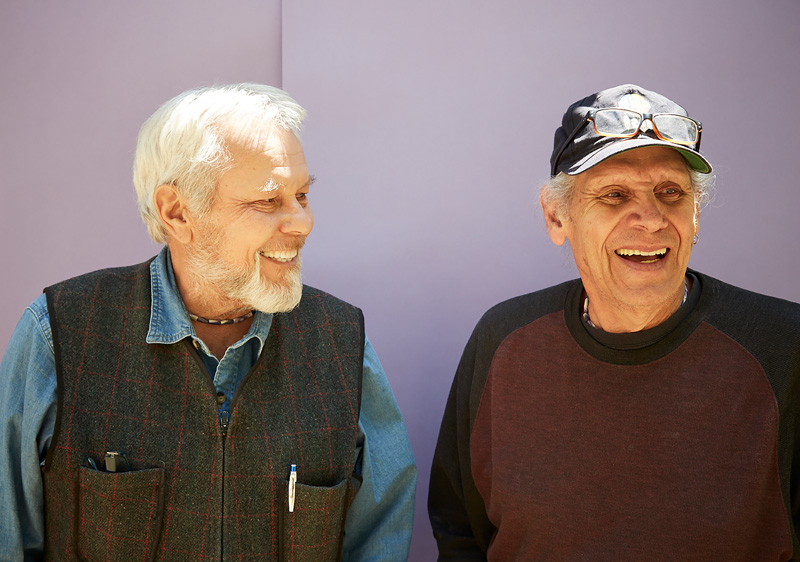
Donald Widdiss and Frank Rapoza turn quahog shells into illustrations of history and creativity.
The pure white and deep purple hues of the quahog shell found in Martha’s Vineyard waters have been used in crafting for many thousands of years — the ancient practice continues today, as the descendants of the Island’s first inhabitants adopt their own interpretation of wampum.
There are also many non-native Island folks who are working with quahog shell and developing their individual relationship with the medium.
Arts and Ideas visited Donald Widdiss and Frank Rapoza at a tucked-away shop in West Tisbury that the two often share to discuss their distinctive takes on working with quahog shells. Upon arriving, Widdiss and Rapoza were busy using the diamond grinder and shell snips to shape beads for Widdiss’ jewelry and tesserae for Rapoza’s mosaics. Widdiss took the snips, which looked like a small pair of sharp pliers, and methodically chipped away at a piece of quahog shell until a rectangular box began to take shape. He then placed the unfinished piece in front of a wheel with abrasive diamond shards and began to press gingerly. The two were willing to share their stories and insights on their unique crafts.
“I started working with shell back in the early 90s. I had a Native American art gallery in Oak Bluffs — we would mostly have Algonquin and Iroquois artists,” Widdiss said.
Widdiss, a Wampanoag Tribe of Gay Head elder, went to the Massachusetts College of Art in 1966 to study art illustration and graphic design, and eventually started making his own screen prints. He got married, had a child, and eventually ended up working in an administrative position for the Wampanoag Tribe of Gay Head (Aquinnah).
“That was a 180-degree turn from my background,” Widdiss laughed, “but it had to get done. In the meantime, the tribe was dealing with issues of Native American Sovereignty, land rights, jurisdictional issues and such.”
In the 70s, the shell fishing industry was booming on the Vineyard, and Widdiss enjoyed going out on his boat to get quahogs. He saw that a number of local people were already working with the shell — Kate Taylor, Joan Le Lacheur, and others — and took it upon himself to develop his own style.
“I didn’t apprentice with anyone; I didn’t want to know how anyone else was doing it. I wanted to make it my own,” Widdiss said.
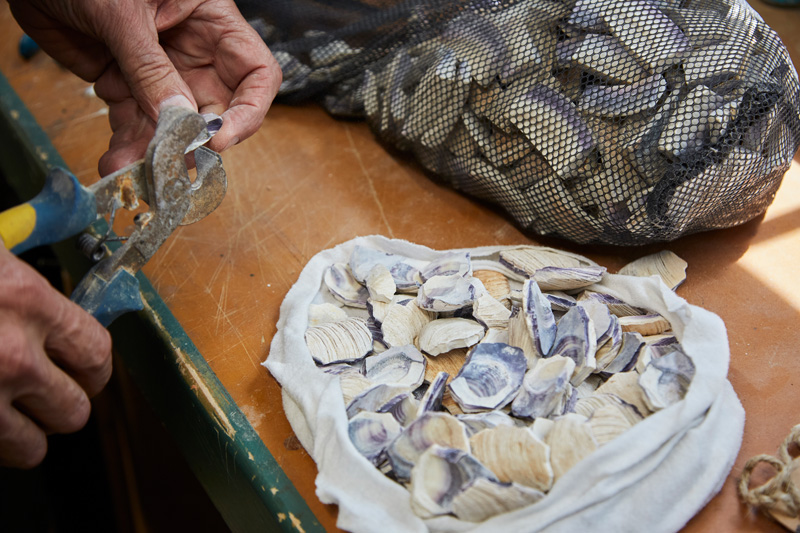
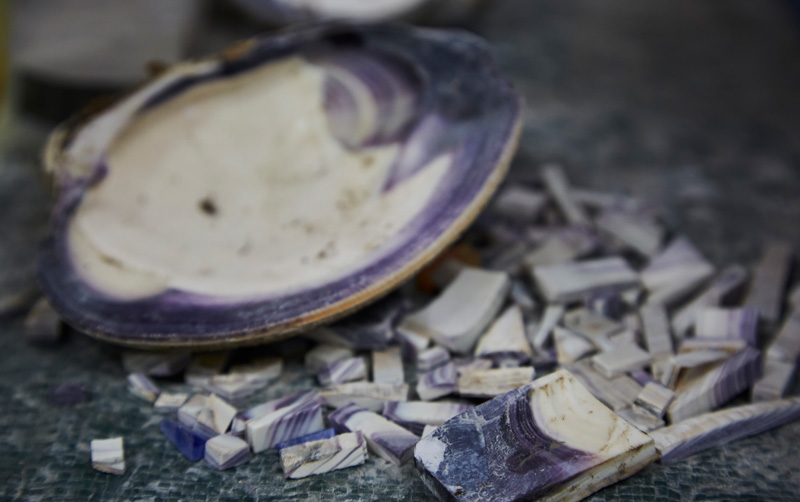


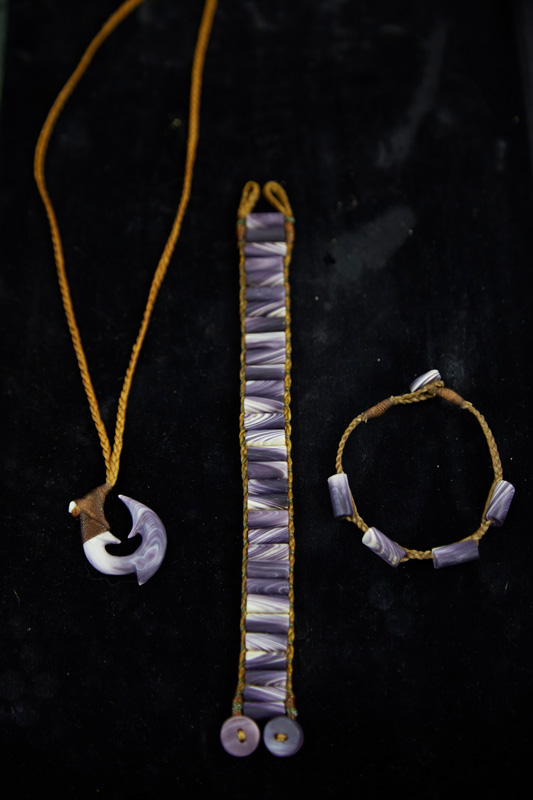
The first thing Widdiss began making was wampum bracelets, often giving them away to tribal elders and old friends, or trading them for more quahog shell. Eventually, folks in the tribal community began requesting the tubular beads that the word wampum specifically refers to.
(Wampum originally comes from the word “wampumpeag,” with “wampum” meaning white shell that’s drilled, and “peag” meaning purple.)
“I got a diamond drill, and began working in this style that is distinctive and beautiful, but it also gets you talking about what the beads are, and what the historical importance is,” Widdiss said. “It’s a very specific meaning, but the term has become generic, and to the general public, it refers to some kind of jewelry or craft made out of quahog shell.”
In Wampanoag culture, wampum was (and in many cases still is) used for decoration or personal adornment, and was historically worn to denote status. Wampum was given as a sign of respect, a dowry, or woven into a belt to be used as a pneumonic device.
“Contracts and treaties were contained in the early wampum belts,” Widdiss said. “One of the earliest belts was an attempt to explain the relationship between natives and settlers. You have the Indigenous people and the Europeans on parallel paths, but never touching. But that’s not the way it worked out.”
Over the years, Widdiss said he has seen some people (including non-native crafters) honor and respect wampum by learning about its history and not trying to over-monetize and cheapen the craft.
“There are craftspeople, there are artists, and there are opportunists. You can argue who falls into each one of those categories,” Widdiss said. “In my mind, if you don’t take the time to understand what a piece is, then it’s just a bauble.”
For Widdiss, working with wampum allows him to connect to his culture, history, and home, just as his mother did when working with the multicolored pastel clay of the Gay Head Cliffs.
“When she would lay that clay out on the table to make pottery when I was a boy, she would tell me that it makes her feel at home,” Widdiss said.
Frank Rapoza offers another take on working with quahog shell. Right out of high school, he apprenticed as a boat builder for the Concordia Company, a yacht boatyard in his hometown of South Dartmouth. Afterward, Rapoza moved to Mystic Seaport to become a shipwright, working on large vessels like the Shenandoah.
Rapoza became inspired to create complex wampum mosaic tiles around 20 years ago while living aboard a boat off Cuttyhunk. A caretaker on Nashawena Island, Manny Sarmento, was known for making a number of religious wampum mosaics for the Cuttyhunk Church. Rapoza decided to try it out. He didn’t ask anyone for help or advice — he purchased bushels of quahog shells and taught himself.
“At that point, I was making what some people call art. I don’t call it art, I call it wampum mosaics,” Rapoza said. “The general public can decide whether what someone does is art or not.”
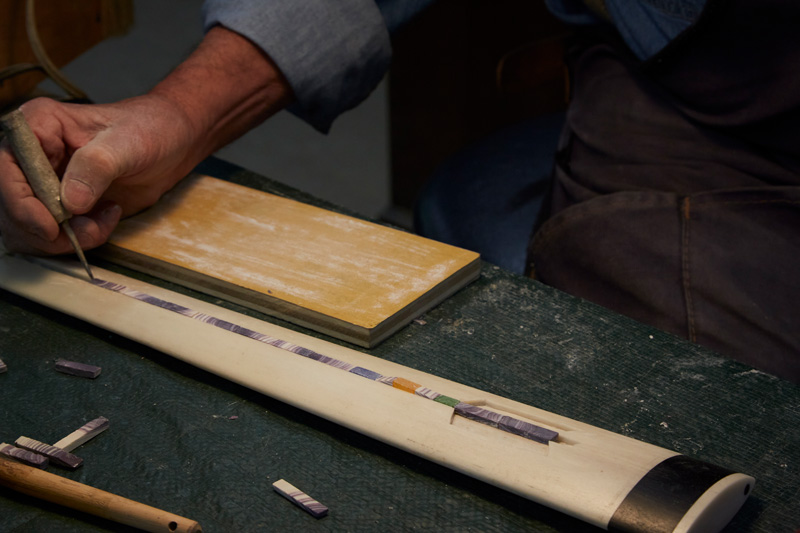
Over the years, Rapoza said he has made around 75 mosaics. He uses small pieces of quahog shell, crushed shell, abalone, semi-precious stones, and other materials arranged precisely to paint stunningly complex pictures. The first couple of panels Rapoza crafted allowed him to formulate his style and determine refinements.
“Right at the start, the mosaics didn’t have any rhyme or reason. They were all jagged and not flush at all. Now, I really have it down, and can do a sketch or have an image in my head of what I want a piece to look like in the end,” Rapoza said.
Rapoza’s first couple pieces took him forever. He would buy large amounts of quahog shell from a commercial fishing fleet in New Jersey so that he didn’t have to worry about running out. “I knew I was going to waste a lot of shells and a lot of time kind of learning and figuring out my process, so I would just buy a ton of them,” Rapoza said.
Rapoza walked over to a table that contained a number of mosaics. He pointed to one simpler design using only purple and white quahog shell.
“That was my first mosaic,” he laughed. “Looking back, it’s almost embarrassing. But my first show that I had, all my stuff sold, so I guess people liked it.”
Eventually, Rapoza started implementing other elements into his mosaics. He began crushing his leftover shell shards, running the dust through a screen, and mixing it with epoxy so he could paint with it. He also began inlaying swordfish bills with shell — a particularly unique craft that you’d be hard-pressed to find anywhere else.
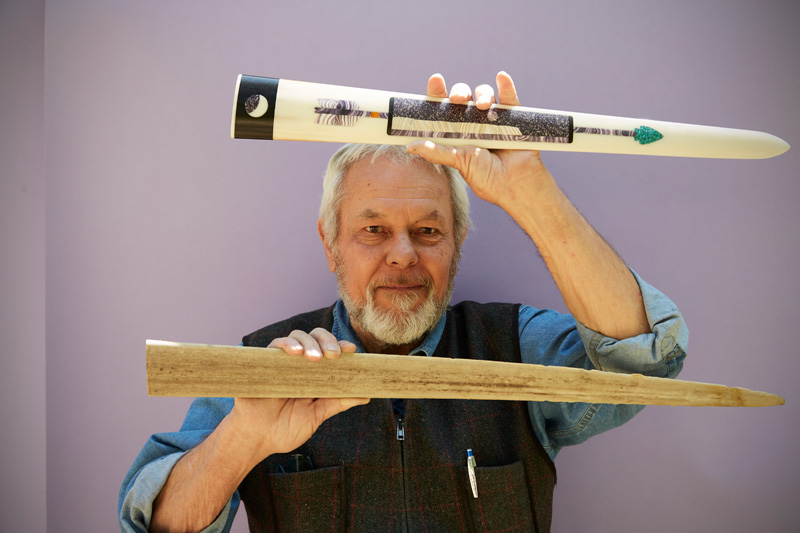
Nowadays, Rapoza’s work is almost entirely on a commission basis. People see his custom mosaics or inlayed swordfish bills and want to have one to commemorate a special event or honor a loved one.
“This one guy commissioned me to do two swordfish bills for his sons,” Rapoza said. “He had seen a previous piece of mine that depicted a moon rising over the cliffs and wanted me to do the exact same scene, except each of the two moons were the phase of each of his son’s birthdays. I was really proud to do that.”
Another unique quality of Rapoza’s mosaics are his ebony wood frames. The deep, dark, and hard ebony wood for the frames comes from the shipwreck of the schooner Dolphin, which struck the rocks off Cuttyhunk in 1854 on its way to Boston with a cargo of ebony logs. The logs were to be used to make parts for musical instruments, such as piano keys and windpipes for bagpipes.
“I think that’s a pretty cool aspect of what I do. You can’t really find wood like this anywhere else,” Rapoza said.
Although Rapoza doesn’t think he would ever take on an apprentice, he said he would like to see someone else start making similar mosaics, and witness another fresh interpretation of the craft.
“I don’t want anyone looking over my shoulder while I’m working, and it’s tough to teach people this stuff,” Rapoza said. “But I would like to see another concept of this really unique thing.”
The work of Donald Widdiss and Frank Rapoza will be exhibited at a show at the Farm Neck Golf Club on Monday, August 21, from 4 to 7 pm.