
First in 2008 and again in 2022, United States Supreme Court justices assured us that their close textual reading of the Second Amendment revealed its original meaning: Americans have a nearly unlimited right to carry any kind of gun anywhere they please.
Textual interpretations of the Second Amendment depend on the grammatical link between “militia” and “the right” to bear arms as understood in colonial times. The challenge before us is this: How do we read a colonial English sentence?
As a result, these are the most studied 27 words in American legal history: “A well regulated Militia, being necessary to the security of a free State, the right of the people to keep and bear Arms, shall not be infringed.”
The 1791 wording seems ambiguous. But it isn’t. The Second Amendment is a perfectly formed sentence. We only have to understand its grammatical construction.
The conservative majority approach was led by Justice Antonin Scalia, who followed the principle that “only the written word is the law.” For the meaning of words, he consulted both the 1773 edition of Dr. Samuel Johnson’s A Dictionary of the English Language and Noah Webster’s 1828 American Dictionary of the English Language.
He correctly noted that the Second Amendment is a single sentence in two parts. So far so good. He argued that the two parts divide naturally into a “prefatory clause,” rambling harmlessly about a militia and a more important “operative clause” that unambiguously guarantees a right to have any gun at any time. And he wasn’t alone. Other judges and ideologues repeated Scalia’s reference to the first part of the amendment as a “prefatory clause,” beginning a chain of grammatical misreadings. They’ve no excuse for it. It isn’t a prefatory clause. It isn’t an independent clause or even a dependent clause.
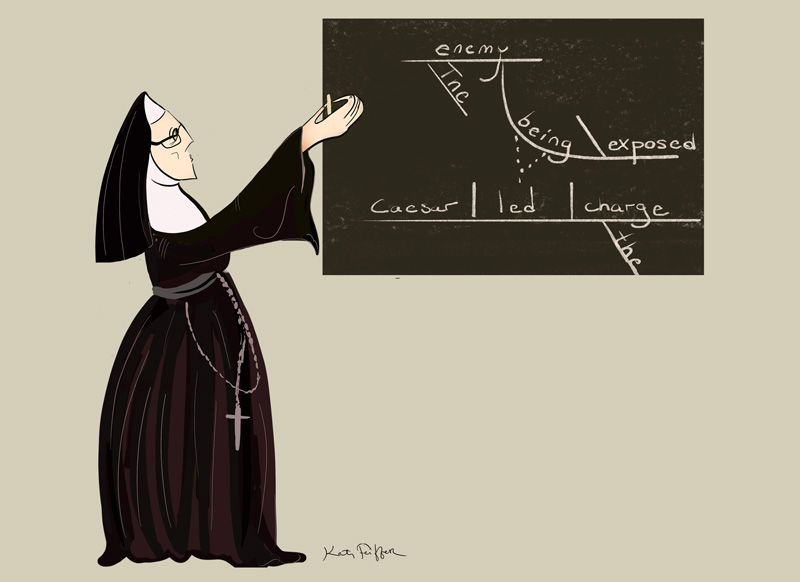
A clause in traditional grammar requires a subject and a predicate, a fact that was instilled in me by the Sisters of St. Joseph of Carondelet starting in the sixth grade. Of the six justices who attended a Catholic elementary or high school, not one has offered a correct grammatical reading of the amendment. Surely some must have spent as many hours as I did at the chalkboard, diagramming sentences into nouns, verbs, participial phrases, direct and indirect objects, dependent clauses, adverbial modifiers, and other parts of speech. I can picture Justice Scalia trying to wriggle his way out as Sister Kathleen Mary admonishes him for fabricating his own grammatical rules.
The point here isn’t a neglected grammatical technicality. The Heller decision rests solidly on Justice Scalia’s faulty grammatical analysis of the way the sentence’s two parts are linked. To Scalia’s claim that the well-regulated militia “clause” doesn’t “grammatically” limit the operative clause concerning the right of Americans to bear arms, Sister Kathleen Mary would have responded, “Wrong! The exact opposite is true grammatically.”
Once again: Who’s correct?
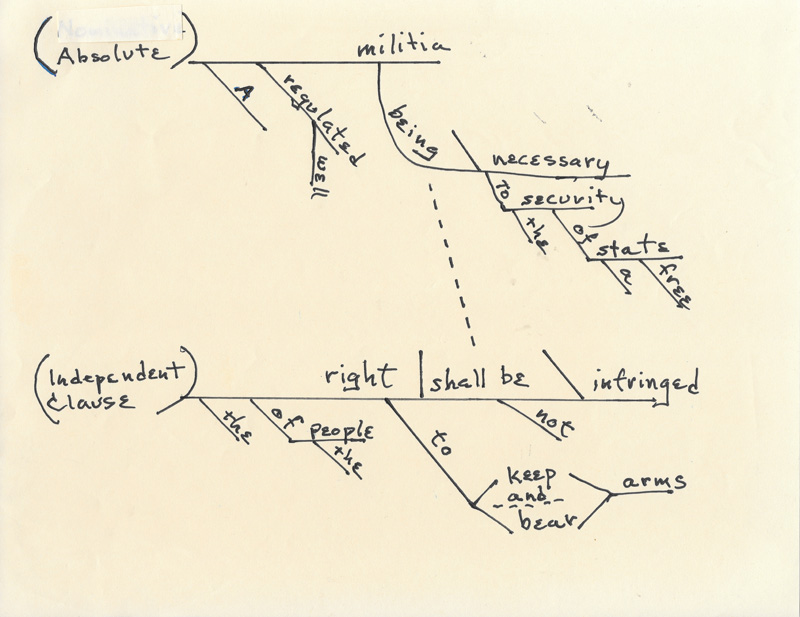
While diagramming sentences has grown less fashionable in literacy education, it remains an effective tool for revealing how a sentence’s construction determines its meaning. Let’s look at a diagram of the Second Amendment:
The top line of the diagram illustrates that the first part of the sentence is not a grammatical clause because the subject (militia) isn’t followed by a predicate. It’s modified by a participial phrase. Looking past this grammatical distinction was the initial mistake in a string of grammatical falsehoods that distort the sentence’s meaning while failing what might be a sixth-grade grammar test. Rather than saying anything about the positive right to bear arms, the linkage only specifies a condition under which the right may not be infringed.
The first part of the sentence is a form borrowed from Latin called an ablative absolute. In Latin, this grammatical construction is widely used to define the time or cause for an action. It’s linked in meaning to the rest of the sentence but is otherwise grammatically independent or free-floating. A translated example of such a Latin sentence might be: The enemy being exposed, Caesar led the charge.
The diagrammed sentence looks like two separate statements, but the first gives the reason or moment for Caesar’s charge. It’s called absolute (absolūtum) because it stands apart from the rest of the sentence. But it expresses the cause or occasion for the main action of the sentence, why or when Caesar led the charge.
The absolute is a powerful construction that can simultaneously combine the reason and time for an action. A study of Latin helps here but is not necessary. We can see how temporal and causal meanings overlap in an English sentence like The day being rainy, we stayed home. A sentence like this offers a dual understanding of when and why we stayed home (because and when the day was rainy).
To avoid a shouting match between the justices and the Sisters of St. Joseph of Carondelet, let’s accept, for the moment, Scalia’s use of “prefatory clause” in a general lawyerly way. Even if he labels it incorrectly, he seems to acknowledge its grammatical function in saying it “announces a purpose.” He concedes that the right to “bear arms” must serve the “stated purpose” (at least in part) of having a “well regulated militia.” His point is that the clause announces a purpose — but not the sole purpose — of the right to bear arms.
Here’s where he makes a grammatical error in how the two parts of the sentence are linked. The grammar of the sentence doesn’t announce a purpose for the right to bear arms. It announces when and why the right shall not be infringed. The diagrams above show that absolute constructions never modify the subject of the sentence but always the predicate. The Second Amendment doesn’t say we can’t own guns to go hunting or maybe even to defend ourselves when necessary, but the right for such purposes can be infringed, as already happens when we restrict the times of year that we can shoot elk or the kinds of guns we can own to do so. The Second Amendment uses the absolute construction borrowed from Latin to give us the reason and occasion for the main command of the sentence — when and why the right to keep and bear arms for a well-regulated militia shall not be infringed.
To those textualists and originalists who complain that what’s pertinent here is the “plain meaning of the text as understood when written in English, not Latin,” we have to point out that several Founding Fathers had a classical education and frequently wrote with absolute constructions. James Madison, who wrote the Second Amendment, was an expert Latinist who learned the language at 12 and later translated many Latin orators. In a memorandum, Madison opened with an absolute, “The conversation being at an end, he took his leave with a cold formality, and I did not see him afterwards.” John Hancock followed suit more elaborately in a letter: “The enclosed Resolves of Congress being necessary for your Information, & Direction, & relative to the Department immediately under your Command, I do myself the Honor of transmitting the same.” The grammatical form was commonplace at the time, and most readers, even without formal training, would understand its use.
Absolute constructions also aren’t grammatical fossils irrelevant to current English. Today, we still use sentences that contain free-floating absolutes to modify verbs in just the same way that is done in the Second Amendment. These are familiar phrases such as “All things being equal,” “Everything being considered,” “Weather permitting,” “God willing,” or “That being the case.” Here’s another example of an absolute construction defining the reason and occasion for an action: “The first draft of the Second Amendment being repetitive and clunky, James Madison revised it.”
Here’s Madison’s first draft:
The right of the people to keep and bear arms shall not be infringed; a well armed and well regulated militia being the best security of a free country: but no person religiously scrupulous of bearing arms shall be compelled to render military service in person.
In his revision, Madison created a more precise, elegant sentence, comprised of an absolute construction and an independent clause, to become the Second Amendment as we now know it. The grammar of the amendment is clear in both its original and current meaning. What becomes unclear are multiple legal and historical interpretations spawned by rephrasing it.
The words of the Second Amendment don’t guarantee citizens an individual right to gun ownership. They say nothing about a protected right to keep guns at home or in the street for self-defense. In 1791, the grammar of the amendment would have been understood to declare the limited circumstance for when and why the right to bear arms could not be infringed. And I’ll add here an originalist historical note to buttress this textualist reading: In colonial times, members of state militias were expected to supply their own weapons.
Chief Justice Roberts’s oft-repeated proverb that “the want of a horseshoe nail leads to loss of the kingdom” indicates how an initial mistake can create a disastrous chain of causation. Unfortunately, the want of a correct textual reading of the Second Amendment leads to the disastrous loss of its originalist meaning. As Sister Kathleen Mary might say: The Supreme Court has many powers, but altering English grammar isn’t one of them.
This essay was originally published in May in the Los Angeles Review of Books and is here revised for Martha’s Vineyard Arts & Ideas, along with drawings by Kate Feiffer.
Frank Bergon has published 12 books, most recently a memoir, “The Toughest Kid We Knew: The Old Knew West: A Personal History.” He is currently writing a novel set in Chiapas, Mexico, during the recent Zapatista revolt.