
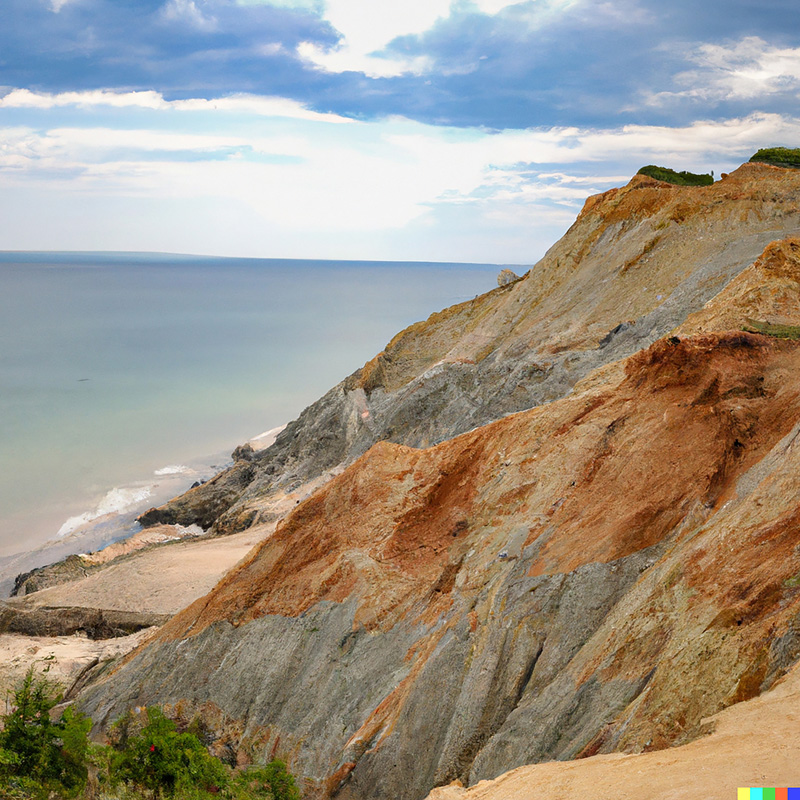
Artificial intelligence collides with a charming-but-quirky Island.
What if…
It’s Labor Day Weekend, the Vineyard Artisans Festival at the Ag Hall. Crowds of tourists and locals mill around the ceramics, quilting, jewelry, woodcraft, photography, and painting. But there’s an especially large and animated throng around one display — onlookers two, three, and four deep, riveted to a large oil canvas, mesmerized, murmuring.
“It’s powerful, as if you’re right there.”
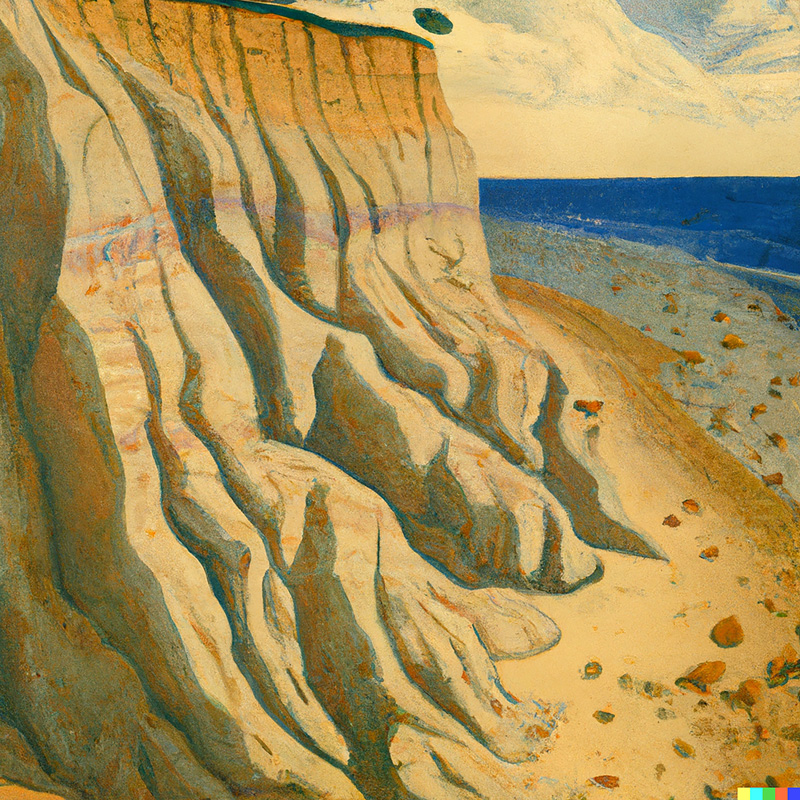
“I’ve never seen the Gayhead Cliffs captured like this.”
“The ochres and oranges of clay are alive, literally alive.”
“The brushstrokes seem to carve out the sides of the earth.”
“The contrast of the white sand and water — my God…”
“There’s the tip of the lighthouse at the edge of the Island … the faint light across the morning sky…”
“It’s just breathtaking.”
“How much is it?”
“No price tag. It could go for thousands. Maybe more.”
“Who’s the artist?”
“Who did this?”
“There in the corner … the artist’s initials: A.I.”
This painting wasn’t painted by a painter, at least not a painter as we know painters. It was created by A.I. — artificial intelligence. It doesn’t really exist, at least not yet, but it could. Artificial intelligence has suddenly become the most ominous force on earth. So how might AI affect one small island off the coast of the world? Since no one knows for sure where AI will take us, this is not a scientific/technological study, but more a flight of conjecture, guesswork, and what if from experts, speculators, and the rest of us.
Okay first, what is AI?
“Artificial intelligence is the simulation of intelligent human behavior by a machine,” so says Susan Epstein, professor of computer science at Hunter College, author of over 150 publications, expert in “complex problems that harness human expertise and exploit the power of modern machines,” and a summer Chilmark resident. Referring to her definition of AI, she adds, “and who’s the judge of what’s intelligent? That’s a good one.” Generative AI, the new subset of artificial intelligence (via chatbots like ChatGPT) gathers information and turns out “seemingly new, realistic content — text, images, or audio – for a wide variety of tasks,” per the Boston Consulting Group.
So what’s the big deal? We’ve had data, automation, and big data for a long time (in tech time, perhaps thirty years). They changed life, but mostly in ways that made it better or easier — the internet, smartphones, streaming video. They brought us access to things, but they didn’t achieve “the simulation of intelligent human behavior.” They didn’t create new things, or think, or do our jobs. That’s the big deal — and maybe the scary part.
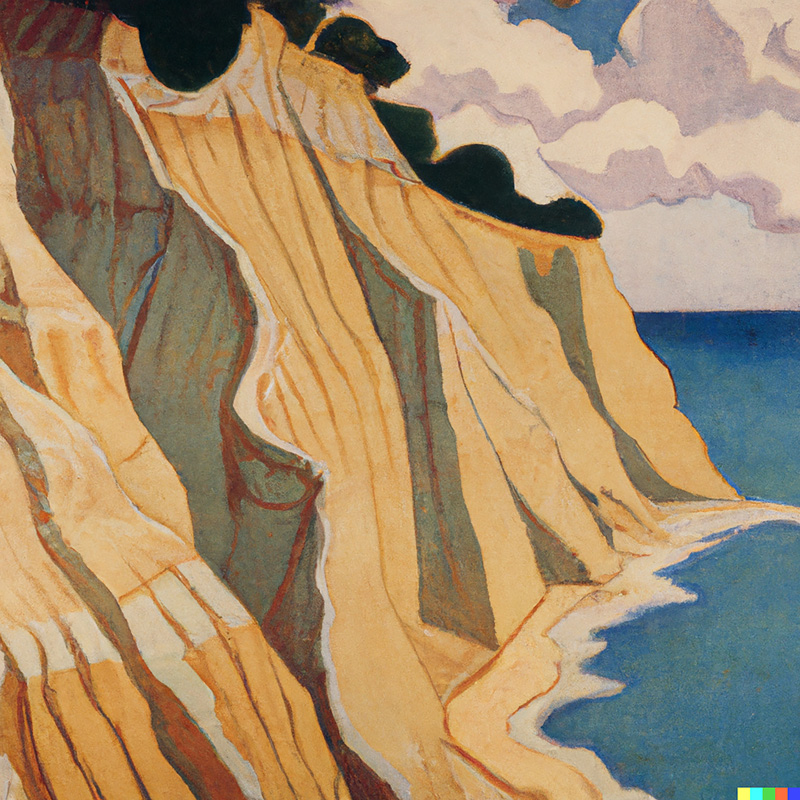
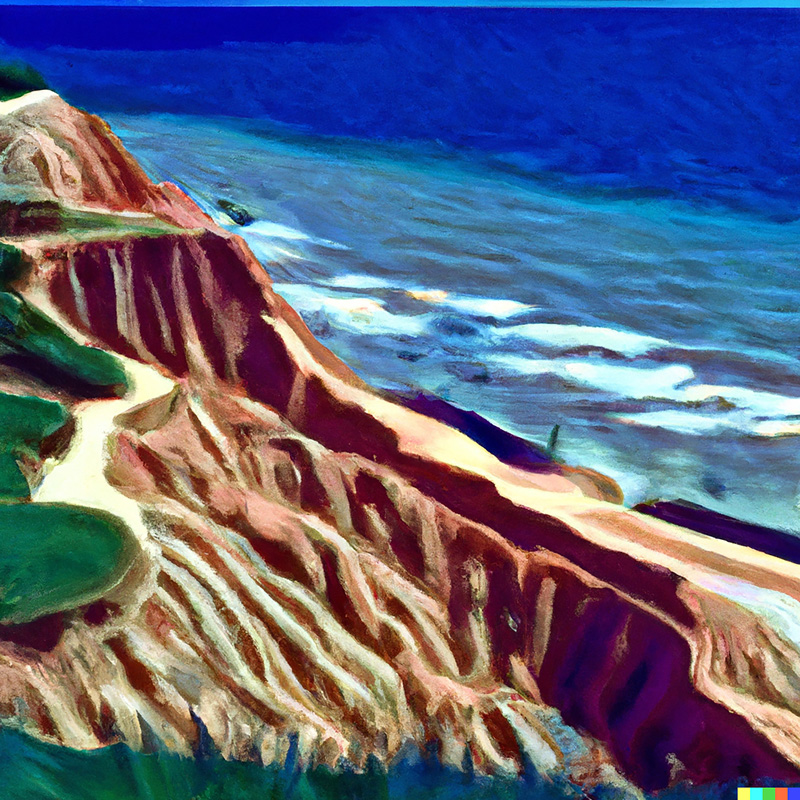
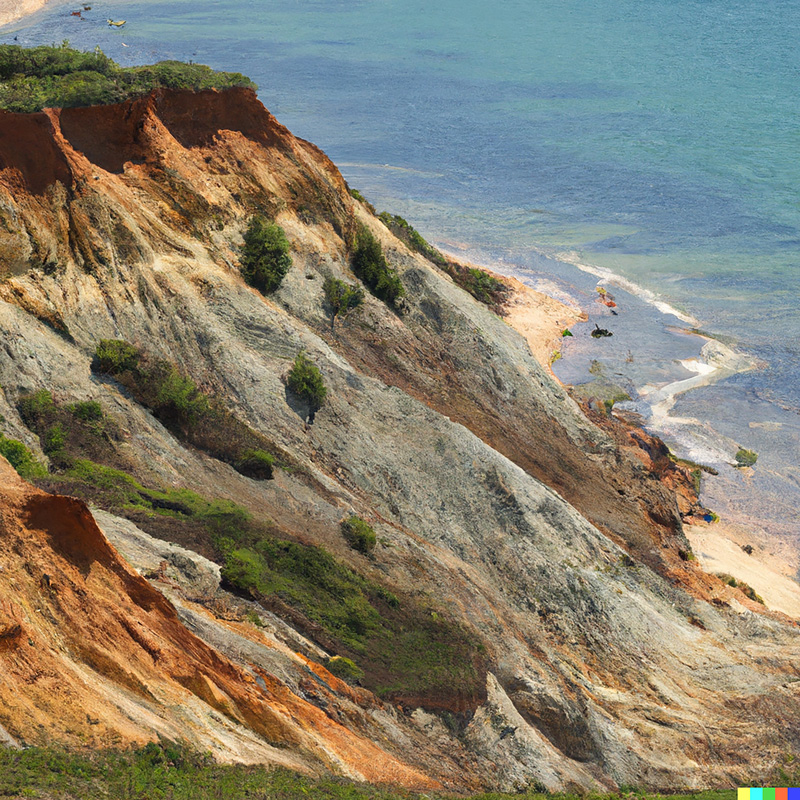
AI can write novels or screenplays, create award-winning photographs, compose music in almost any style, and yes, paint a breathtaking landscape of Gay Head. AI cannot empathize, sympathize, or make love … so far. But it can alter life as we know it, performing tasks — from the mundane to the sophisticated — previously done only by humans or human thought. Things involving commerce, the arts, science, entertainment, finance, and labor in places like New York, Paris, Silicon Valley, Abu Dhabi, Beijing, Moscow, and almost everywhere in between.
So what might it do to life on our Island? How will artificial intelligence impact a place that staunchly resists traffic lights, even at intersections ominously called Five Corners and The Triangle? A place that has no chain retail or restaurants (unless you count Dairy Queen, Stop and Shop, and gas stations)? A place most often reached by steamships (invented in 1807 by Robert Fulton), of which there aren’t enough, and often your only hope is waitlist or prayer? A place where skunks can spray their way through family picnics or fancy bistros, but are evidently a protected species? How will the futuristic power of artificial intelligence collide with a charming-but-quirky Island named for an explorer’s daughter who didn’t actually have a vineyard?
Tom Davenport, distinguished professor at Babson College, research fellow of the MIT Initiative on the Digital Economy, author of five books on the subject, summer resident of Falmouth with a front-porch view of the Vineyard, and frequent Island visitor, says, “Until recently, I was quite optimistic that AI was going to be large-scale augmentation of human work rather than large-scale automation of human work. But (now that) this generative stuff came along and proved so capable. …I’m much more worried now than I was a year or two ago.”
Jonah Lipsky, born and raised on the Vineyard, computer programmer and playwright, who is writing a play about AI entitled “Cut It Out,” says, “It occurred to me that the Vineyard might be slightly insulated from some forms of automation because it’s a closed system in some ways.” An island, literally. He goes on, “But on the other hand, maybe it will be just as susceptible to job losses and such because the Vineyard is driven by this seasonal tourist economy.”
So jobs like real estate agent, fisherman, chef, waiter, golf pro, traffic cop, lawyer, journalist, artist, photographer, or travel agent might disappear, or at the least, shrink. AI and its close relatives, robots and drones, could do a lot of things, some good, some not good, some questionable. Drones could deliver blood and medicines to the hospital or directly to patients. Robots could not only stock supermarket shelves but, armed with generative AI, predict demand to know when to put which foods out and how much to charge. Machine learning could load ferries, utilizing geometry and logic to optimize every ship’s capacity. All that would be efficient but could eliminate a lot of jobs. Ironically, that might alleviate some of the housing shortage … but that could also further polarize the Island’s economy. Robots could handle real estate open houses, or crack lobsters, or build homes. Chatbots could draft a summer rental contract, teach sailing, or even give Island poet laureates a run for their rhymes. The Vineyard has two newspapers (while most places are lucky to have one), so might AI replace reporters or even eliminate one or both papers? Might this article be written by ChatGPT? Couldn’t this all happen? Yes. And even the toughest select board can’t create zoning laws to bar AI from MV.
How does AI do this nefarious stuff? Renee Richardson Gosline, senior lecturer in Management Science at MIT Sloan School of Management and head of Human-First AI Group at MIT’s Initiative on the Digital Economy — and devoted Vineyard summer visitor — explains that AI “regresses to the mean,” or the mathematical average — that which is between extremes. “So if you are relatively mainstream, if you essentially want a continuation of what’s already out there, then AI makes more efficient the replication of that.” It produces output that most people find acceptable most of the time. A pleasant vacation itinerary, a standard cover letter for a summer job, a list of popular beach novels, and some typical scenic photo spots. But it doesn’t stray from the mean.
But is Martha’s Vineyard the “mean”? Maybe our being insulated, an island, is our salvation. John Sundman, self-described hardware/software/science tech writer who escaped to Martha’s Vineyard to become a truck driver, firefighter, and science fiction author, says, “…yes, on Martha’s Vineyard we are insulated a bit from today’s modern world over there in America.” And that might be a good thing. Could a place that is purposely different, purposely away from mainstream, an island literally and figuratively, create an alternative to AI by focusing on the uncommon denominators?
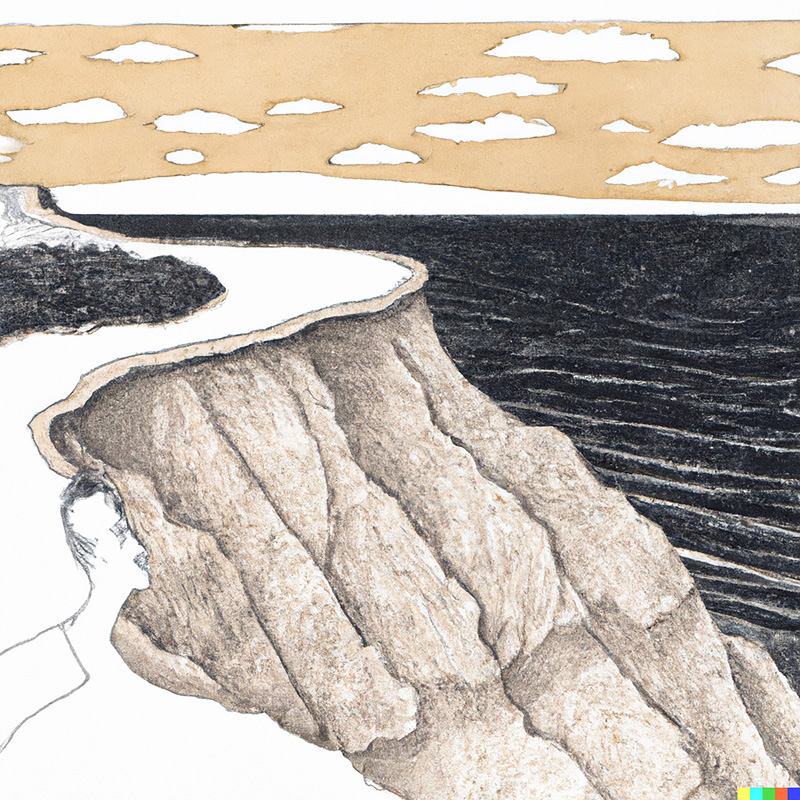
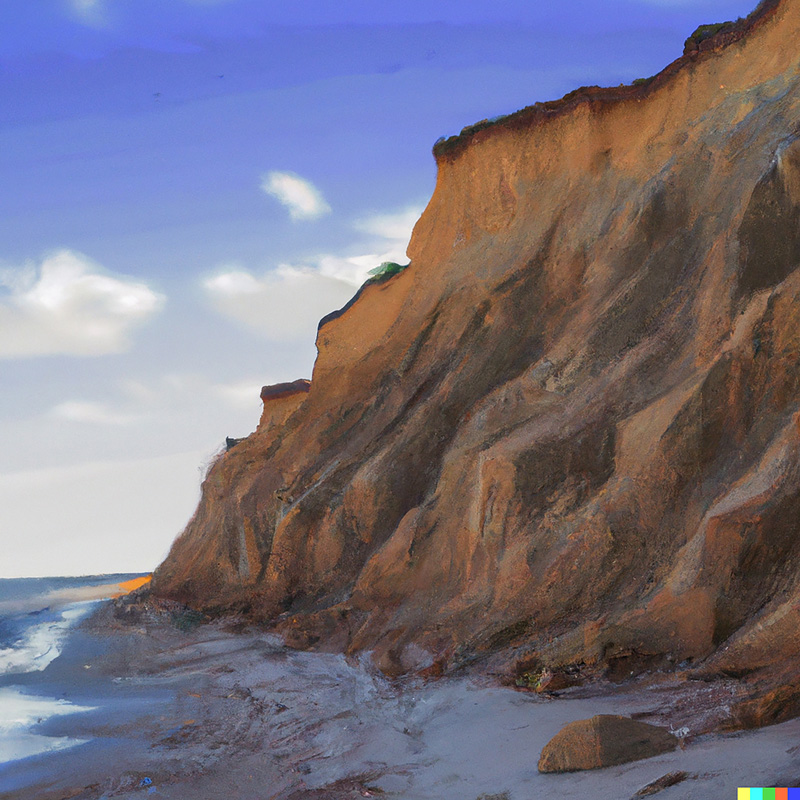
Yes, a beautiful painting of the Gay Head Cliffs could be created by “regressing to the mean,” that is going to the trillions of bits of data and “scraping” the most popular images of cliffs, the most desired views, the sun rising or setting at the most favored times, a lighthouse — which is always a winner — and perhaps a flock of birds. But maybe an honest-to-God, painted by a human holding a brush in hand, oil painting or watercolor of Chappy or Stonewall Beach or Sengekontacket, displayed next to that “generated” art will be even more prized, more valuable. After all, it’s real. The same goes for hand-carved bowls at the Chilmark Flea Market. And low-light photographs taken at dawn over Menemsha. And handcrafted, bead-by-bead Wampum bracelets at Aquinnah. Real things create their own market and demand and panache. Maybe the restored whaling captain’s house turned B & B, or the local secret recipe chowder, or the fishing trip with the old guy who knows where the stripers are, or the Flying Horses, or Illumination Night, or jumping off the bridge, or the porch in Chilmark where you might see undercover celebs chowing down on pizza, will set Martha’s Vineyard apart from a commoditized world. Diverging from the mean. Maybe Island life will thrive, not only in spite of, but because of AI.
Or maybe it will be something in between. Susan Epstein has coined a term, “collaborative intelligence.” She says, “The idea is, there are things machines are good at and things people are good at. There’s no reason to make one of us do something others are better at, whether it’s multiplication or holding someone’s hand.”
While some jobs might disappear, others might be created. There’s a whole new category referred to as prompt engineers, humans who can make AI work better. They feed specific criteria into a platform like ChatGPT to help it produce more usable output. So instead of a local tour guide having a rather generic website churned out by AI, with the help of a prompt engineer AI could help highlight specialized tours of Cottage City, or the captain’s houses of Edgartown, or the best hiking trails. The newspapers might have fewer reporters but more editors, acting as prompt engineers to assure accuracy in articles, to prevent a story that mistakenly refers to the Vineyard as Cape Cod or worse, Nantucket. Humans doing what they do best and machines doing what they do best.
Some people refer to these prompters as “AI whisperers.” Humans who whisper to the machines to make them more accurate, more specific, less “scraping data” and perhaps more Vineyard-y. Maybe a whisperer could even give AI clues on how to manage that pesky skunk problem. One expert, Babson and MIT’s Tom Davenport, in a departure from his usual weighty work, suggested we use image recognition software to track the skunks’ routes, coupled with foods that encourage or discourage their trespasses. It could work, assuming the whisperer didn’t have to get too close to the skunk.
Maybe life as we know it will change seismically. Or maybe not. Maybe, as Jonah Lipsky sees it, “Humans aren’t evolutionarily adapted to live in sort of deconstructed communities.” So maybe we’ll resist, not just on the Vineyard, but everywhere. What else explains the resurgence of vinyl records in a digital music world? Or the popularity of minor league baseball games like the Sharks over the glitz and hype of major league venues? Or the rise of in-person concert-going like Beach Road Weekend? So, who knows? John Sundman, the sci-fi guy, says, “My crystal ball is in the shop, getting repaired.”
Oh, by the way, that painting of the Cliffs at the Artisans Festival might have had the lighthouse on the wrong side of the Island, on the southeast corner, not the northeast, because the landscape had a gap that needed to be filled and lighthouses are always popular, so it dropped one in. After all, it’s what most people like most of the time. But it’s not real. It’s not Martha’s Vineyard.